#279 | ‘Motherless Brooklyn’, a Truly Inventive Crime Novel—and Why You Should Never Underestimate Anyone
Quick SUMMARY:
Douglas Vigliotti kicks off 2026 by spotlighting Jonathan Lethem’s crime novel "Motherless Brooklyn." Vigliotti explores Lethem’s genre-blending career and the book’s unique and inventive protagonist, Lionel Essrog, a private investigator with Tourette’s syndrome. He discusses the novel’s plot, themes of found family, mentorship, loyalty, reinvention, and embracing differences, sharing favorite quotes and personal reflections. The episode also highlights the importance of not underestimating people and judging them by appearances.
Listen to the episode:
LISTEN ON: Apple or Spotify 🎧
*Subscribe to The Books for Men Newsletter, a monthly round-up of every episode with full book and author info, all the best quotes, and newsletter-only book recommendations!
TOPICS COVERED IN the EPISODE:
Introduction to the Episode (00:09) - Host introduces the podcast, episode, featured book, and companion newsletter.
About Jonathan Lethem (01:08) - Overview of Lethem’s career, genres, notable works, and writing style.
Lethem’s Career & Writing Risks (02:08) - Discussion on authors taking stylistic risks, financial realities, and Lethem’s teaching role.
Detective Story & Film Adaptation (03:15) - Introduction to "Motherless Brooklyn" as a detective story and its 2019 film adaptation.
Plot Overview & Main Character (04:09) - Summary of the book’s plot, protagonist Lionel Shrag, and unique elements like Tourette’s.
Themes & Character Analysis (05:12) - Exploration of themes: found family, mentorship, loyalty, difference, and reinvention.
Favorite Quotes & Their Meaning (08:37)- Host shares and analyzes favorite quotes, focusing on character relationships and underestimated qualities.
Closing Remarks & Contact Info (10:49) - Host wraps up, promotes his book, and shares ways to connect and subscribe.
READ THE TRANSCRIPT:
Welcome back to “Books for Men”, a podcast to inspire more men to read and bring together men who do so. This is the first week of 2026, and I am featuring an excellent crime novel, one that I really enjoy. I thought it would be a good way to start the year, and it is titled “Motherless Brooklyn” by Jonathan Lethem. It is around 311 pages, came out in 1999, and I'm going to share a lot more about the author. The book, of course, has some of my large takeaways, why you should read this book, what you could take away from it, as well as a couple of my favorite quotes. But as always, I wanted to quickly remind you about the companion newsletter that goes with this podcast. And that's just a once-a-month email that rounds up all of the episodes from that month, complete with full book and author information. All of my favorite quotes, episode summaries, and additional book recommendations. So if that's something that you are interested in, or maybe you're sold, you want to sign up for it. All you have to do is head over to the website BooksforMen.org.
01:11 - All right. So now let me pivot into the reason why you are here. “Motherless Brooklyn” by Jonathan Lethem. As always, I like to start with the author. He's written 13 novels, a bunch of short story collections, and a handful of essays. Most of his work crosses between three genres, I would say crime or crime noir, sci-fi, and literary fiction, which was the basis of his debut in 1994. So, five years previous, the novel that I'm sharing with you today, the title of that was “Gun, with Occasional Music”; other than the book that I'm sharing with you today, probably his other most well-known novel is “The Fortress of Solitude”, which came out in 2003. The thing I love most about his career, I would say, is that it doesn't feel boxed in by a specific genre in his books usually have an inventive structure, which to me is just more fun to read and engage with. As a reader, of course, there's nothing wrong with a formula, so to speak.
02:08 - A lot of writers that I enjoy write a very specific thing, and commercially they are successful with that thing. But it's refreshing to see authors who take risks stylistically, book to book. I should note that he is also a creative writing teacher and a professor at Pomona College. I think this helps him, or anyone who has a backstop, to be a little bit more risky with their work because they're not relying solely on books to pay their bills, so to speak. And that creates a different type of pressure for a writer, just as it would for any creative person who's making their living solely off of that thing. But with books specifically, I think you will find that this is more the norm than it is the anomaly, so to speak. It's really hard to make money solely off your books, especially if you are doing risky or inventive things with them, because it's not falling squarely in a genre, so to speak. I find his writing to be very energetic and easy to read, almost like Richard Price, who was probably my favorite crime novelist of all time.
03:15 - Coincidentally, he's also someone whom I once heard say in a PBS interview. Of course, he said this facetiously, there are only 12 novelists in the world that don't have a second job, and I'm not one of them. Going hand in hand with that idea that it's just really hard to make a living off of your books, even for someone who is what I would consider to be pretty successful. You know, Richard Price being that person, and Jonathan Lethem, too. And I don't know what their financial state either of them are. I'm just making assumptions here and having fun talking about this, as I see it, as something that is integrated into the publishing world, that is maybe unseen to the average consumer or reader. Having said all that, the book that I'm sharing with you today is a pretty straightforward detective story with a big spin. Perhaps this is why it did so well at Norton. Actually brought it to the big screen in 2019, but I think it's not even remotely the same as the novel.
04:09 - Sure, it carries the same main character, someone that Edgar Norton plays extremely well. It's just a really good fit. And I think if you've ever seen Ed Norton in any of his work, like “Primal Fear” or “The Score”, you'll see maybe why this main character is such a good fit. When I jump into the story, which will be just in a second here. But I did want to mention that that movie fuses together the story of the famed crooked, powerful New York City planner Robert Moses. Or there's a character modeled after him, and he has nothing to do with the novel at all. So Ed Norton really takes liberties and creates an original story, utilizing “Motherless Brooklyn” as the basis. Anyway, with all that being said, I should probably just tell you now more about what the story is about. Essentially, it's the story of Lionel Essrog, a private investigator with Tourette's working for L&L moving, an investigation agency that is masked as a transportation company, and he is investigating the murder of his boss, Frank Minna.
05:12 - So basically, Lionel was a foster child, along with a slew of others, hence the name “Motherless Brooklyn”, who was brought along by Minna at a young age. Assuming this sort of street-like father figure, who then suddenly dies one day while they're on a job. And this kicks off the story, right? So it goes to some unsuspecting places, stretching from Brooklyn to Maine to Japan, encompassing things like Zen and traditional elements of noir, like a femme fatale character, as well as just in its tone. I think it's very noir-esque. Ultimately, it's the inventiveness, something you've heard me say before of a P.I. with Tourette's that makes this novel really stand on its head, which not only is something that was new and had never been done prior, or at least not to my knowledge, it also makes it feel like a magnifying glass on the endless chatter that dominates all of our minds. I think that we could relate a lot to Lionel in a way. And of course, the execution on a sentence level is what really just makes it work for me.
06:22 - As is the case for most books that have a very straightforward plot, the author's got to do it in a compelling way for it to actually work and be gripping. But it's also funny, right? Because Lionel is always shouting out or thinking these random things uncontrollably, and he has this really great quote that kind of sums up what Tourette's or his tic actually is, early in the novel. And Letham writes: “For me, counting and touching things and repeating words are all the same activity. Tourette's is just one big lifetime of tag. Really? The world or my brain? Same thing. Appoints me it again and again, so I tag back. Can it do otherwise? If you've ever been it, you know the answer.” I thought this was really funny and a clever way to explain the urge and the necessity for Lionel to be blurting these things out and thinking these random things. It's really a hard book to balance and pull off for this reason, but it makes the book definitely more elevated, even for sitting squarely in a genre like crime or noir or what have you.
07:36 - This is something that I typically love and really appreciate. Consequently, it's something that I try to do or emulate with my own work. Thematically, the book covers found family, mentorship, loyalty, and being different, you know? Most notably, it shines a light on Tourette syndrome. Right? So this idea of difference and appreciating differences, and they often use the word freak in the novel. And we're all freaks on some level, and I really related to that. But it's also a story about reinvention, as many of the characters do that throughout the course of the story or in the actual story. For me, it's just a really great crime novel that's super fun to read. I thought it would be a great way to kick off the year. And yeah, I think I've done enough to tell you what this story is about. I'm not going to ruin the ending. I do think Letham lands it, which is something I'm usually a stickler about with all stories. All right, so I will end this by sharing a few of my favorite quotes from the book.
08:37 - And this one is an attempt to explain Frank Minna's worldview. So I said that he's like a mentor or that street mentor type of figure. And there's a part that happens early in the novel where he writes: “If you weren't funny, you didn't quite exist, and it was usually better to be fully stupid, impotent, lazy, greedy, or freakish than to seek to dodge your destiny or layer it underneath pathetic guises of vanity or calm. So it was that I, Overt Freak Supreme, became mascot of an entire worldview.” I thought that was so clever to explain the strange, unique, but endearing and sincere relationship that Lionel had with Frank Minna and how much he actually loved him in this weird, wacky way that most people probably would never understand. But that quote kind of sums it up. Another one-liner that I really enjoyed came at the end of the novel, and it's from a female character to Lionel, and she said: “He said the reason you were useful to him was because you were so crazy everyone thought you were stupid.”
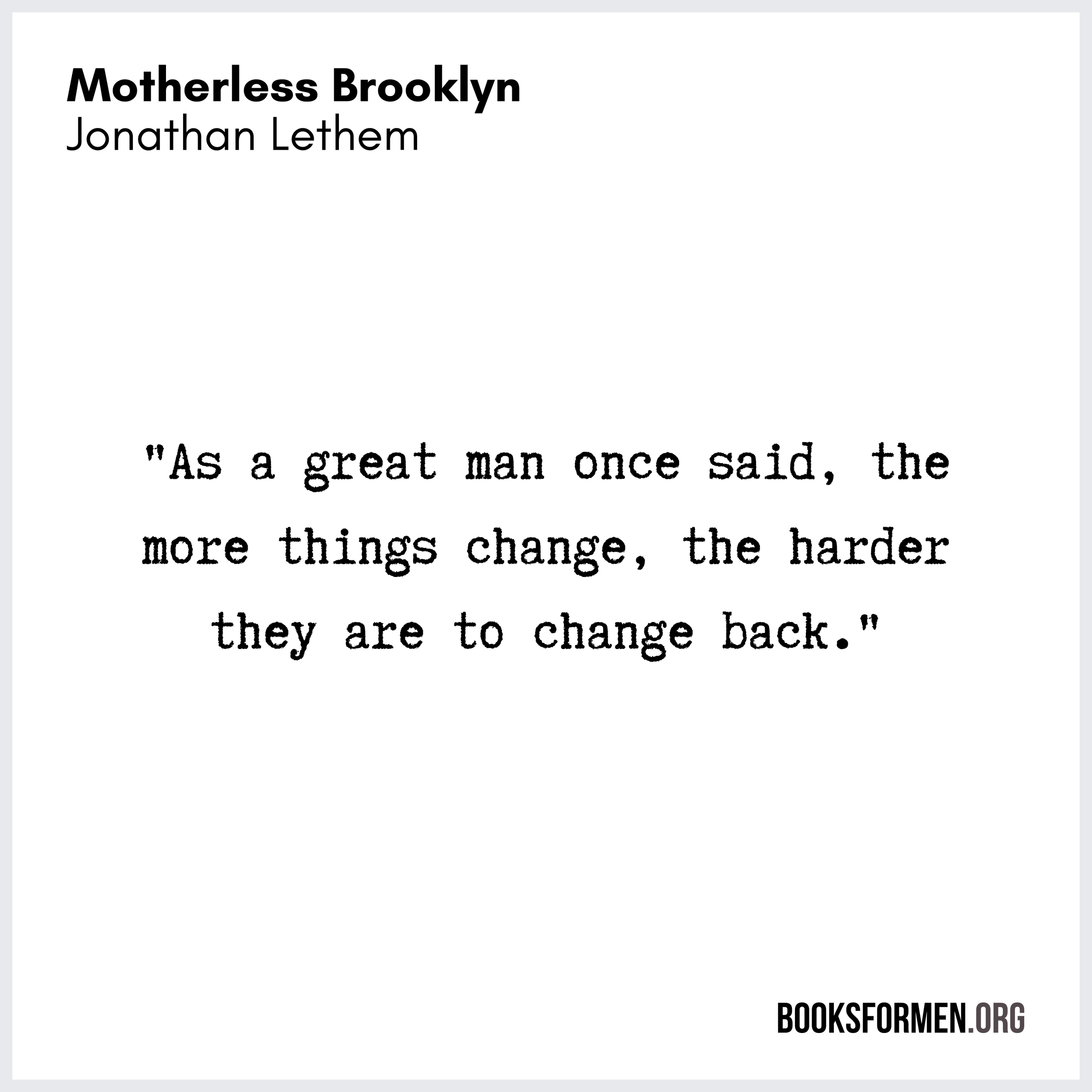
09:53 - There's so much about this quote that I love first, this idea that people underestimate certain people, and this happens all the time in life because we confuse one quality with another quality. In psychology, they call this the halo effect. So if someone's tall, they must be trustworthy. If they're nice, they must be truthful, that type of thing. Basically, it means one thing doesn't prove another thing. Yet we often confuse things together. This is a powerful example of not underestimating people. And then when you just look at the quote on the nose, I think that's probably indicative of a lot of artists. So many of them are, quote unquote, crazy, but many of them are not stupid. And I think that it's just so easy to bundle somebody's being, quote unquote, crazy into so many other things that may or may not be true. All right. So for the sake of time, I'm going to wrap this up. I want to thank you so much for listening.
10:49 - I think you'll like this book if you do pick it up. And of course, if you are enjoying this episode or the podcast more broadly, please remember to click subscribe on whatever podcast platform you're listening to this on. It is the best way for new listeners to find the show and hence inspire more men to read. If you want to connect with me, there are two ways to do so: on Instagram @DouglasVigliotti. It's the only social media that I have or via my website DouglasVigliotti.com. I do have a book out titled “Aristotle for Novelists: 14 Timeless Principles on the Art of Story”. Some people like it, some people love it, some people hate it. You have to pick it up to find out which bucket you fall into. If you are interested, you could find out more about it at AristotleforNovelists.com. Last but not least, if you want more information on this podcast specifically, which includes signing up for that newsletter I mentioned at the top of the episode, then all you have to do is head over to the website BooksforMen.org.