#278 | Special Edition: “One Plus One Doesn’t Equal Two” (+ Big Updates for 2026)
Quick SUMMARY:
In this special year-end episode of "Books for Men," host Douglas Vigliotti shares his pop-up piece "One Plus One Doesn’t Equal Two" and reflects on embracing uncertainty and mystery in life. Vigliotti announces major updates for 2026: the podcast will focus exclusively on fiction, with a new "Advice for Men" series on alternate weeks. He discusses the unique value of fiction in an AI-driven world and encourages listeners to find meaning beyond facts. Or as Vigliotti calls it in the essay, “…life’s ultimate skill.”
Listen to the episode:
*Subscribe to The Books for Men Newsletter, a monthly round-up of every episode with full book and author info, all the best quotes, and newsletter-only book recommendations!
TOPICS COVERED IN the EPISODE:
Introduction to the Special Edition Episode (00:09) - Douglas introduces the episode, explains its special format, and reminds listeners about the monthly companion newsletter.
Year-End Reflections and the Importance of Checkpoints (01:19) - Douglas reflects on the significance of the New Year as a time to reset and recalibrate, especially for adults.
Big Podcast Updates for 2026: Fiction Focus (02:16) - Announcement that the podcast will focus exclusively on fiction books in 2026, with rare exceptions for creative nonfiction.
Why Fiction Matters in the Age of AI (03:38) - Douglas discusses the unique value of fiction versus nonfiction, especially as AI makes information more accessible.
Advice for Men Series Announcement (04:45) - Introduction of a new series, "Advice for Men," to be featured on alternate weeks in 2026.
Episode Structure for 2026 (05:50) - Explanation of the new alternating format: one week fiction, the next week advice for men.
Pop-Up Piece Introduction: “One Plus One Doesn't Equal Two” (05:50) - Douglas introduces and contextualizes his pop-up piece, inspired by a visit to the Met and a Jackson Pollock painting.
Reading of "One Plus One Doesn't Equal Two" (07:06) - Douglas reads his reflective essay on uncertainty, art, knowledge, and the metaphorical nature of life.
Reflections on the Piece and Closing Thoughts (09:45) - Douglas connects the piece to the episode’s themes, thanks listeners, and encourages subscribing and connecting.
Contact Information and Final Reminders (10:50) - Douglas shares how to reach him via Instagram or his website, and reminds listeners about the newsletter.
READ THE TRANSCRIPT:
Welcome back to “Books for Men”, a podcast to inspire more men to read and bring together men who do. So this week is going to be a special edition episode where I feature a pop-up piece that I typically only share on Instagram, so it lasts for only 24 hours on my story. I usually write it that morning, but I did make mention of this piece when I did the episode on “Gulliver's Travels”. It is titled “One Plus One Doesn't Equal Two”, and I thought it would be a good way to close out 2025. I'm also going to share with you some pretty big updates for 2026. But first, I just wanted to remind you, if you are a new listener, that there is a companion newsletter that goes with this podcast, and it goes out once a month, and it just rounds up all of the episodes from that month, complete with full book and author information, all of my favorite quotes, and additional book recommendations. So if that sounds like something that you are interested in, or maybe you are already sold, then you can sign up on the website BooksforMen.org.
01:19 - All right, so before I share those updates and the piece, of course, we are when this episode airs in between the Christmas holiday and New Year's. So it's right at the end of the year, that last week of the year. But I did want to wish everybody, obviously, a Happy Holiday, whether it's Christmas, Hanukkah, or just a new year. You know, it's always a time to reset and recalibrate. And it's definitely something that I do. I think as you get older, one of the challenges is building checkpoints into your life, because everything can feel like a hamster wheel when you're younger. There are built-in checkpoints, so you go to school for a set amount of time, and summer for a certain amount of time. You go back to school for a certain amount of time, and there are just all of these checkpoints that are built in. That breaks up the year. But as you grow into an adult, it's not as easy to find those checkpoints. And I think the new year, for a lot of reasons, is a really good one.
02:16 - So I hope everyone has a safe and happy New Year and, more importantly, a healthy and prosperous one. On that note, I did want to share what some big changes will be for 2026. So I've put a lot of thought into this, and I'm actually going to be moving into fiction only for 2026, meaning there will not be any nonfiction that I share on the podcast. Maybe there might be some creative nonfiction. So stuff like memoirs or things of that nature, but you can expect mostly fiction. Nonfiction for me. And this is kind of sad to say, but in a way, it's becoming extinct with the advent of AI. Meaning if you're looking for something that's solely going to provide you with information. So you want to know more about a specific creator or person, or an idea. Time period in history. It's very easy for you now to utilize ChatGPT, Perplexity, Claude, or any of these extremely satisfying AIs to learn about these topics in a very compelling way. Sure, it's not a book, and it will never be a book, but for me, I just feel like there is more of a necessity now in fiction.
03:38 - And I think that the piece that I am going to share with you today, one plus one, doesn't equal two, relates to this idea. And not just that, I'm more interested in fiction. It's something that I write. So, although you haven't seen any of my latest work, the last three books that I've written are all novels trying to sell them currently to a publisher, so we'll see how that goes. But anyway, I am really focused on fiction in a lot of ways. And so I just wanted to continue to perpetuate that form on the podcast. Now, you might be saying to yourself, Well, you could do the same thing with fiction. If I want to learn about a book, then I could just ask ChatGPT. And this is where I think fiction and nonfiction are vastly different. You can learn what a novel is about, but you can't experience it unless you read it. I can't say the same for a biography about Leonardo da Vinci, and I do think there is something to be said for a specific angle at which someone comes at a subject matter, and that's why I think that there's still a place for creative nonfiction.
04:45 - But anything that is solely trying to provide you with information, I'm not sure how it fits into this new world. All to say that for me, I'm reading a lot less nonfiction these days. I'm reading a lot more fiction, and I just think that art has a huge place in this new world that we are heading towards, because of how distinct it is in what it provides to the consumer of it. The second big thing for 2026 is, on the off week. So, fiction is not going to be every single week. On that off week, which typically would have been a nonfiction book, I'm going to be starting or trying this new series called Advice for Men. I like to think of it as shit. I tell my friends, so this is stuff that I talk about all the time, and I go back to the well with over and over again, as I'm in conversations with my friends about bigger things, about life, and I thought that it would be fun to share some of that stuff with you, and we'll see how it goes. So one week will be a work of fiction, and the other week will be Advice for Men, Shit I Tell My Friends. I hope you enjoy that. Anyway, let's turn now to the pop-up piece that I wanted to share with you. So I should let you know that I wrote this piece that I am about to read to you on the heels of visiting the Met, and that will put in context the opening line and perhaps why I wrote the piece to begin with. It is titled “One Plus One Doesn't Equal Two”.
6:25 - How many people have stared at this Jackson Pollock, contemplating its meaning?
This, I submit, is what I love most about all art—books, movies, music. It doesn’t provide answers, only questions. In that way, it's the best metaphor for life.
I used to have an unhealthy obsession with “knowing,” so I read books and listened to podcasts that I thought made me smarter. More knowledgeable. More knowing.
Now I realize it was just an effort to control uncertainty. As in, if I know more, I’ll be safer. I’ll avoid pain. Life has taught me this is a lie. I’m not suggesting you maintain total ignorance because fools take on too much existential risk. Life and death are real.
But you’re not safer because you know that 1 + 1 equals 2. You are more neurotic, though, when it doesn’t. Perhaps this is the main problem of our dating culture, which, as it turns out, is now its own existential risk. We are not creating enough babies at a rate to sustain the human species. Or more frankly, we are having less sex, trying to add up the numbers.
The catch, of course, is that in life, 1 + 1 rarely equals 2. That only happens on paper. In math. In science. In the latest AI model. All serving our age-old, egotistical, innate desire to control the world around us.
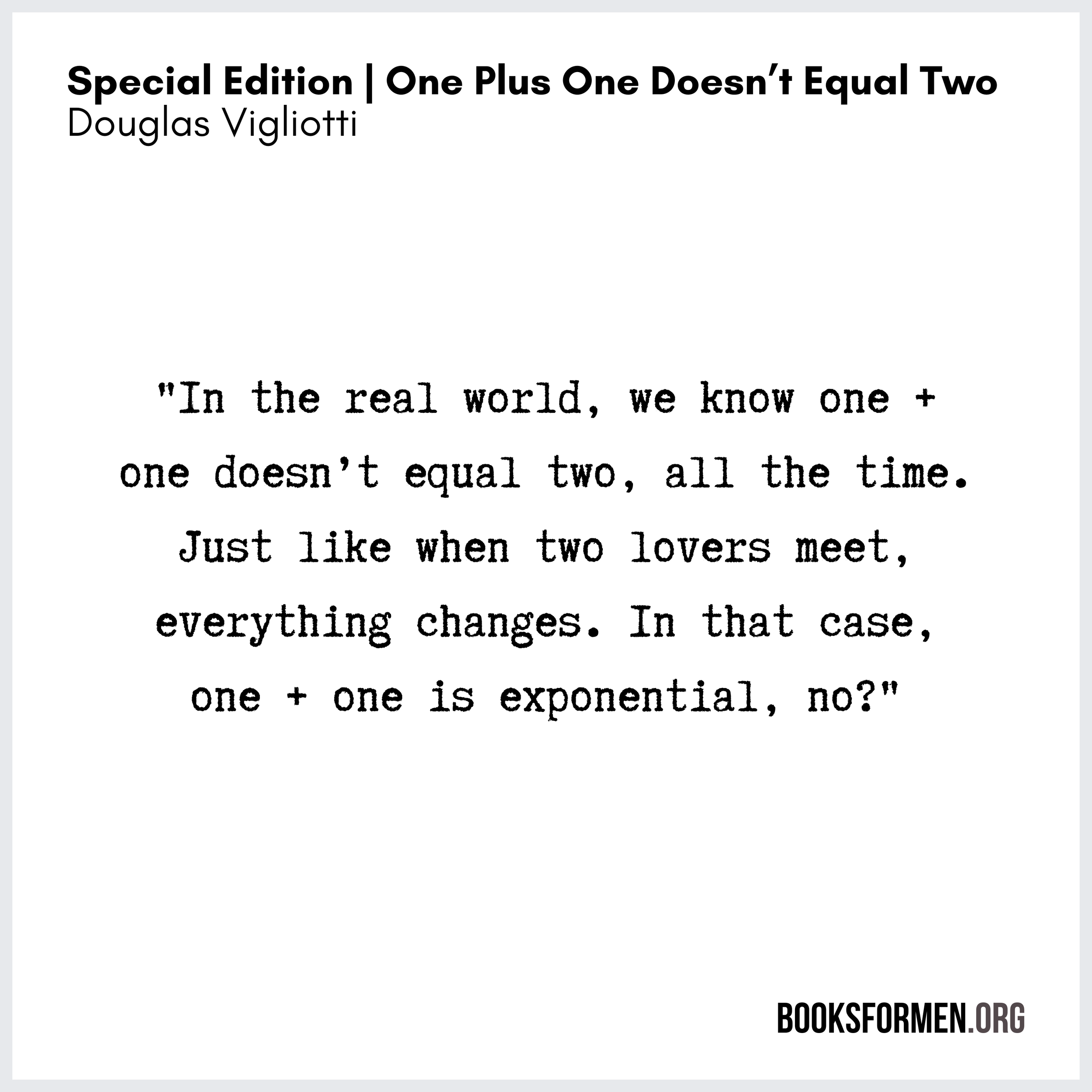
In the real world, we know 1 + 1 doesn’t equal 2 all the time. Just like when two lovers meet, everything changes. In that case, 1 + 1 is exponential, no?
But we’ve wound up in this strange “literal” world devoid of metaphor, where 1 + 1 must equal 2, we must know the answer, and we must understand. Now. Now. Now. If not, we move on. It’s the drugged-out, perverted version of the Enlightenment. Proof that even great things can go to extremes and ruin themselves. Greek tragedy tried to warn us about this hundreds of years earlier. We didn’t need facts to learn it. We had myth.
Of course, my take will be different than yours. It’s in that difference that a central tension resides. It’s actually the unknowing that makes life and art interesting. Mystery is what’s missing. We need more mystery, not less. Every great story is a mystery. Yours included. As in, what happens next?
It’s learning how to live in this world, a place with ample questions and a lack of answers, that’s life’s ultimate skill. Because the only thing literal about life is death. Everything else is just a metaphor for something else. Meaning is totally up to you.
How many more people need to stare at this Jackson Pollock to realize this?
10:01 - All right, so after reading that, I kind of feel the edginess of the piece more so than the first time that I wrote it or published it. But I definitely see the intertwined with how I led this episode and what to expect for 2026. Maybe getting at how I am thinking about things. On that note, I wanted to thank you so much for listening. I hope you enjoyed the piece and the podcast more broadly. If you did, I want to remind you to please click subscribe on whatever podcast platform you're listening to this on, because that's the best way for new listeners to find the show and, in return, inspire more men to read. If you'd like to reach out, there are two ways that you can do so: on Instagram @DouglasVigliotti. It's the only social media that I have, and if you do connect with me on there, then you're likely to see some of these pop-up pieces that only last for 24 hours. I don't share them all on the podcast, of course, and the other way to reach out to me is via my website, DouglasVigliotti.com. Last but not least, I wanted to remind you that if you want more information on this podcast specifically, which includes signing up for that newsletter, I mentioned at the top of the episode that all you have to do is head over to the website BooksforMen.org.