#281 | What Is the Cost of Comfort?—Aldous Huxley’s ‘Brave New World’ on the Dangers of Endless Technological Progress
Quick SUMMARY:
Douglas Vigliotti discusses Aldous Huxley’s classic novel “Brave New World”. He provides background on Huxley, summarizes the novel’s plot and dystopian themes, and reflects on its relevance to current trends and modern issues, like unending technological progress and its societal trade-offs. Vigliotti shares personal insights, where he thinks the book falls short, favorite quotes, and encourages listeners to consider the book’s questions about individuality, freedom, comfort, and stability, and to continue engaging with thought-provoking literature.
Listen to the episode:
LISTEN ON: Apple or Spotify 🎧
*Subscribe to The Books for Men Newsletter, a monthly round-up of every episode with full book and author info, all the best quotes, and newsletter-only book recommendations!
TOPICS COVERED IN the EPISODE:
Introduction & Podcast Purpose (00:09) - Host introduces the podcast, its aim, and the featured book "Brave New World."
Newsletter Promotion (01:24) - Details about the companion newsletter and how to sign up.
About Aldous Huxley (01:40) - Background on Huxley, his career, and other notable works.
"Brave New World" and "Island" (02:26) - Context on "Brave New World" as a dystopia and "The Island" as its utopian counterpoint.
Plot Summary & World State (03:27) - Overview of the novel’s plot, world-building, and main characters.
Themes: Trade-offs of Progress (04:54) - Discussion of the novel’s central questions about technological progress and societal trade-offs.
Modern Relevance: Social Media & AI (06:06) - Parallels between the novel’s themes and current issues like social media and AI.
Political and Philosophical Reflections (07:18) - Exploration of progressivism vs. conservatism and deeper philosophical questions raised by the book.
Literary Critique & Thematic Power (08:35) - Host’s opinion on the novel’s writing quality versus its thematic impact.
Favorite Quotes & Closing (09:46) - Sharing favorite quotes from the book, final thoughts, and calls to action for listeners.
Final Thanks & Contact Info (10:46) - Thanking listeners, sharing contact information, and newsletter reminder.
READ THE TRANSCRIPT:
Welcome back to “Books for Men”, a podcast to inspire more men to read and bring together men who do so. This week, I have a classic work of fiction to share with you. It also falls squarely into sci-fi, a genre that I don't feature a lot on the podcast. It clocks in at what was originally billed as 311 pages, but I think the modern reprints are somewhere in, like, the mid-twos. It's only 65,000 words. So when I say mid twos, I mean like 250 pages or something of that nature. It came out in 1932, and it's titled “Brave New World” by Aldous Huxley. So it's quite likely that you've heard this title before. It is one that is prominent in the literary canon, so to speak, and I will share a lot more about it. Of course, some of the large takeaways, and why I think you should read it, and why I am actually sharing it with you. And of course, some of my favorite quotes. But before I do that, I want to remind you about the companion newsletter that goes with this podcast, which is just a once-a-month email that rounds up all of the episodes from that month, complete with full book and author information, all of my favorite quotes, episode summaries, and additional book recommendations. So if that sounds like something that you are interested in, or maybe you just want to sign up, then you could do so on the website BooksforMen.org.
01:31 - Okay, so as always, I like to first start with the author. So who was Aldous Huxley? He was an English writer. He actually moved to the US, LA to be specific, in his 30s, where he ended up dying as well in 1963 at the age of 69. But prior to that, he had a pretty prolific career as an author of nearly 50 books. His work spans across nonfiction, essays, poems, and, of course, novels like the one that I'm sharing with you today. I'd say his most well-known nonfiction work is “The Doors of Perception”, which is essentially him documenting his own experimentation with psychedelics but turning back to fiction. Other than the novel that I am sharing with you today, which is undoubtedly his most recognized contribution, “Crome Yellow”, “Antic Hay”, “Point Counter Point”, and “Island” are a couple of his more well-known novels, I would say.
02:26 - And so the novel that I am sharing with you today was actually his fifth and the last novel that I had mentioned there. “Island” came out 30 years later, in 1962, prior to his death. Interestingly, it was a no pun intended, a counterpoint of sorts to a “Brave New World. So while a “Brave New World” is what people would consider a dystopian novel, the “Island” is actually a utopian novel, and I just thought it was sort of interesting that he chose to, I don't want to say rebut, but offer a completely different picture of humanity before he died. Having said all that, instead of yammering on about the author, let's turn to the story and reason why you're here, “Brave New World”. All right, so you don't hear me say this often, but it's hard to describe the novel in a way. Or the plot. I should say not because the book doesn't say anything. The exact opposite, really. It says a lot and makes you consider a lot, which is one of the primary reasons why I wanted to share it with you.
03:27 - But it's hard to encapsulate into a solid narrative. Basically, it's the story of Bernard Marx of the world state, which is a place where babies are artificially created in laboratories and then sorted out on a caste system by their potential and birthright and all of that stuff. And they all have predetermined roles, and they're conditioned in certain ways to believe certain things and act certain ways. And of course, this creates social order and stability and comfort and efficiency in the world state, but at the same time, it sacrifices everything you expect it to. Individuality. Freedom. Family. In a way, they use all different types of. Conditioning with forms of consumption and even a drug that cures sadness and anxiety. But this is sort of only the first aspect of this story. The narrative gets more interesting when Bernard Marx visits the Savage Reservation, which is a place where things are more. Quote unquote, normal. So there's families and religion and natural births. Independence, of course. And when he brings this character called John the Savage back to the world state, the novel really turns more into John's reactions to this abstract world.
04:54 - And this is where the novel really starts to ask a lot of questions of the reader. I mean, it does prior to that as well, but this is where it becomes a lot more obvious, right? And ultimately, if you haven't figured it out yet, this story is a cautionary tale on what can happen if there is unchecked, unending technological progress. Because as one thing gets added, another is lost. This is not only the interesting question of the novel—as in, what are you willing to trade off for technological progress? Or perhaps individually, what are you willing to trade off for? Some of these things that are obvious positive gains in your life, like stability, comfort, efficiency, all of these things on face value are positive. But what are you trading off to get these things? I mean, I consider myself an optimistic person, but I do not believe in utopias. So trade-offs, sacrifice, struggle, and pain are all things that I think come with the beauty of the world we live in and the fortune we have to be born into it.
06:06 - You can't have one without the other. At least not in my viewpoint of the world. So at a certain point, you have to stop and ask yourself, what is the cost of endless progress? Are we trying to rid those things? Because if we are, what are we replacing with it? I think we've seen this narrative play out over the last 15 to 20 years with social media, right, where there was a promise of one thing that, on its face, connection, sounds amazing. And while it might provide the ability to stay connected with people that you otherwise wouldn't have, what has been the cost of that? Are we better or worse because of it? And I think that this novel is really forcing you to grapple with a lot of those ideas on a more grand scale, which now, as we move closer to a world that is AI-driven, you could see this everywhere in the name of efficiency, in numbers and rationality manifesting in different ways. Again, the technologists will want to convince you that there is a utopian outlook for the future where it's all positive and all problems are going to be solved.
07:18 - I don't fall into that camp. I wouldn't call myself a pessimist, but I don't fall into the camp of a utopian future; I just don't. I don't think it's fundamental to human life. In some sense, this novel makes you think about the great political debate, right? So progressivism versus conservatism in the very traditional sense of the words, people who want to continually move things forward and people who want to keep things the same, it's always the people who have want things to stay the same. People who do not have want things to change. That's typically where you see the drawing of the political lines. But what if we get to a point where people who do not have realize that not having is better than endless progress of more. That might mean reform might be the better option. Again, I don't know, but this is the type of stuff that this novel will make you consider or think of. I don't want to keep beating a dead horse. I think you understand what this is all about and what you will have to grapple with as you read this novel, but I did want to just lastly conclude with the big reason why I wanted to share this with you.
08:35 - And it's because to me, this novel is a great example of this is funny, something that is terribly written on a sentence level and maybe even on a story level too. Of course, this is just my opinion, and I'm only one person. Who am I to say it is a novel in the literary canon, after all? But I think that thematically it's just so overpowering that it doesn't even matter. And this is a stark example that you can have one thing and not the other, and that one thing doesn't guarantee another. I think with any work of art, it could be poorly executed but still thematically interesting. And again, who am I to say this? I'm only one opinion. Maybe you would agree or disagree. Either way, I'm not going to change my viewpoint. It's why I wanted to share it with you. And I think it is something that is interesting to draw your eye towards, even if you don't agree, as this is sort of a new insight that I'm bringing to the podcast and may change the way that you read books moving forward.
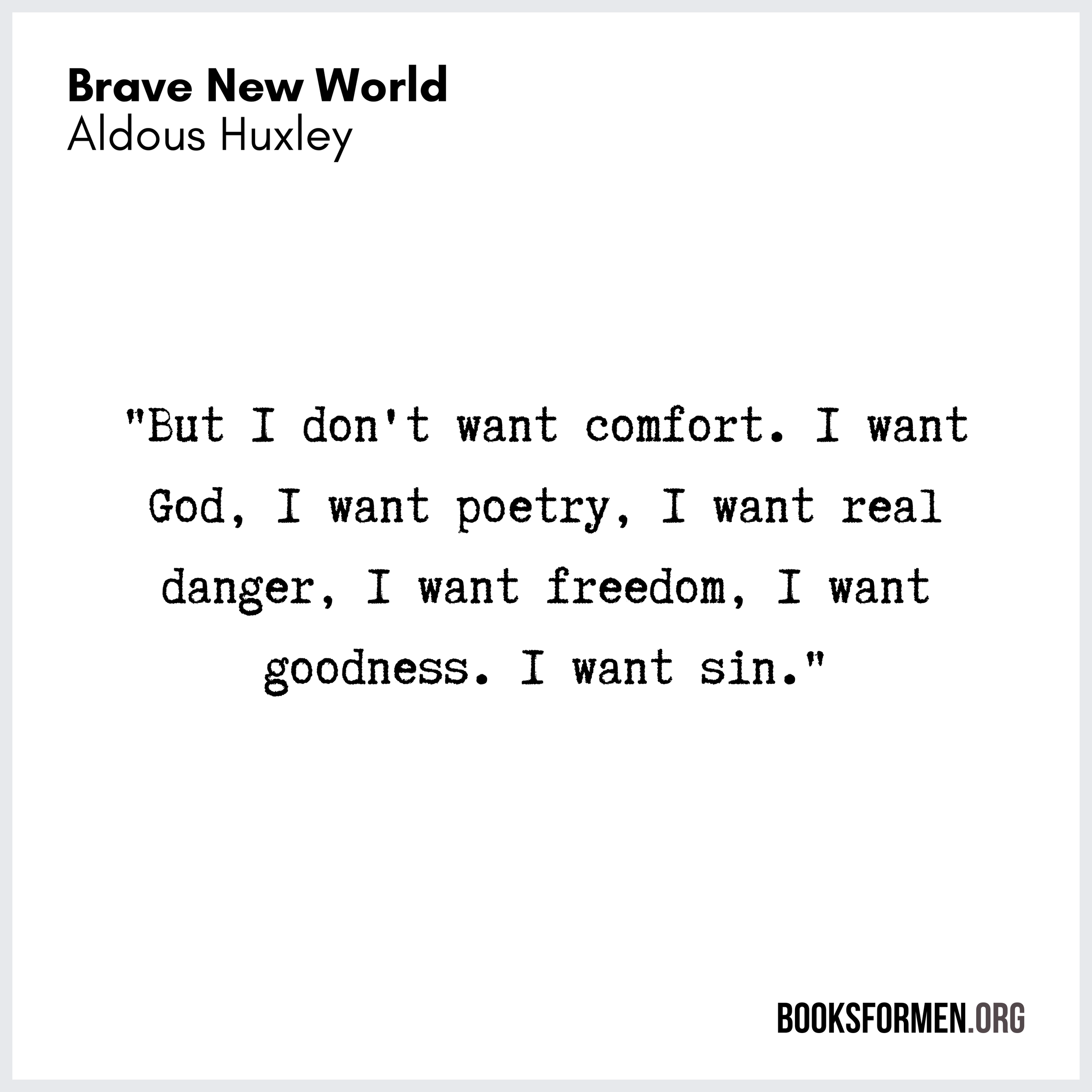
09:46 - I did want to share one quote with you, or actually two quotes with you that both come from John the Savage. And that's how I will end this episode. And he says, “But I don't want comfort. I want God. I want poetry. I want real danger.” And then he goes on to say, after, “I'm claiming the right to be unhappy.” I love these quotes for all of the reasons that I already stated in this episode. I hope you enjoyed it. If you did, I want to remind you to please click subscribe on whatever podcast platform you're listening to this on. It's the best way for new listeners to find the show and inspire more men to read. If you want to connect with me, there are two ways to do so: on Instagram @DouglasVigliotti. It's the only social media that I have or via my website DouglasVigliotti.com. If you're interested in reading my latest book, “Aristotle for Novelists: 14 Timeless Principles on the Art of Story”, you could find out more about it on the website AristotleforNovelists.com. Last but not least, I wanted to thank you so much for listening and remind you that if you want more information on this podcast specifically, which includes signing up for that newsletter I mentioned at the top of the episode, then all you have to do is head over to the website BooksforMen.org.