#285 | Is the Novella ‘Train Dreams’ Better than Its Movie Adaptation?—A Beautiful and Brutal Depiction of How Time Washes Away Everything
Quick SUMMARY:
Douglas Vigliotti launches the first 2026 edition of "Novel vs Movie" by comparing Denis Johnson’s novella "Train Dreams" with its 2025 film adaptation directed by Clint Bentley and starring Joel Edgerton. Vigliotti explores Johnson’s background, the story’s themes of grief, isolation, and progress, and contrasts the novella’s introspective bleakness with the film’s slightly warmer, more dignified approach. He encourages listeners to experience both versions but prefers one for one specific reason. Listen to find out.
Listen to the episode:
LISTEN ON: Apple or Spotify 🎧
*Subscribe to The Books for Men Newsletter, a monthly round-up of every episode with full book and author info, all the best quotes, and newsletter-only book recommendations!
TOPICS COVERED IN the EPISODE:
Introduction to the Episode & Newsletter (00:09) - Host introduces the "Novel versus Movie" series, the novella and film, and promotes the podcast newsletter.
About Denis Johnson and His Works (01:30) - Background on Denis Johnson, his writing style, notable works, and why "Train Dreams" was chosen.
Movie Adaptation and Performances (02:27) - Discussion of the 2025 film adaptation, director Clint Bentley, Joel Edgerton’s performance, and cinematic style.
Plot Summary of "Train Dreams" (03:26) - Overview of the story’s setting, main character Robert Grenier, and the inciting tragedy.
Themes: Grief, Isolation, and Passage of Time (04:37) - Exploration of the novella’s and film’s themes: grief, isolation, progress, and the passage of time.
Symbolism and Title Significance (05:47) - Analysis of the train metaphor, Grenier’s relationship with nature, and the meaning behind the title "Train Dreams."
Book vs. Movie: Tone and Ending (07:03) - Comparison of the book’s and movie’s tone, differences in emotional impact, and the significance of the novella’s final line.
Personal Recommendation and Closing Thoughts (08:16) - Host’s personal preference for the novella, recommendation to read and watch both, and reflection on the story’s message.
Outro and Ways to Connect (09:44) - Encouragement to subscribe, connect via Instagram or website, and information about the host’s book and newsletter.
READ THE TRANSCRIPT:
Welcome back to “Books for Men”, a podcast to inspire more men to read and bring together men who do so. This is the first 2026 edition of Novel vs Movie. It is sort of timely because the movie adaptation is currently in Oscar nomination for Best Picture this year, but the book is titled “Train Dreams” by Denis Johnson. It came out in 2012. It is short, so around 120 pages or so in the movie, as I've already mentioned, came out in 2025. It was directed and written by Clint Bentley, starring Joel Edgerton in the lead, and it came in at about an hour and a half. 103 minutes is what it's billed at, but it's usually a little less than that, which I think is a great length for any movie, especially this one. But before I share anything more about the author story and all of that good stuff and of course, which one I preferred and why, I did want to quickly remind any new listeners about the newsletter that is a companion to this podcast, which is just a once a month email that rounds up all of the episodes from that month, complete with episode summaries, all of my favorite quotes, book and author information, as well as additional book recommendations. So if that sounds like something that you are interested in, or maybe you're just ready to sign up, then all you have to do is head over to the website BooksforMen.org.
01:40 - All right. So now let me turn back to the work at hand. And as always, I like the first start with the writer. Denis Johnson is a familiar name to a lot of people. He's the author of nine novels, not including the novella that I am sharing with you today, and Train Dreams would be considered a novella. His most well-known novel is “Tree of Smoke”, for which he won a National Book Award in 2007, and he's also the author of many plays, poetry, and short story collections, probably most notably and widely recognized for “Jesus’ Son”, which was his debut collection. It really is fantastic. I have it on my bookshelf here. It's about lost souls, addiction, spiritual emptiness, and it's in the same vein, I would say stylistically as Raymond Carver, someone else who I've featured on this podcast.
02:27 - I will link that episode up in the show notes, and I could have done an entire episode on either of those two books that I just mentioned, especially the latter. But I wanted to share this book today because, as I mentioned at the top of this episode, “Train Dreams” is sort of in the zeitgeist right now. And I say sort of because as much as something could be, Netflix did an adaptation of this novella and it got that Best Picture nom, which was not surprising to me because I thought that it was easily one of the best movies that I saw last year, which is why I thought it would make a solid episode for this series, of course. So Joel Edgerton, whom I already mentioned, and I already liked, I thought his movie “The Gift”, which he wrote and directed, was so good. If you haven't seen it, it's clever and often overlooked, but I highly recommend it. But I think he gives maybe his best performance in “Train Dreams”. And just like the author who writes with this deadpan, minimalistic style.
03:26 - Clint Bentley, the writer and director of the film, captures this with the cinematic version, and it's really exclamation-pointed by Edgerton’s pitch-perfect lead. He says so little, but at the same time says so much. And to me, those are always some of the most powerful performances on the screen. Clint Eastwood, Steve McQueen, they did this so, so well. If you've ever watched any of their movies. All right, so before I get too far ahead of myself and start talking about the comparison between the movie and the film, I should probably tell you what it's about. So the story follows the life of Robert Granier, a lawyer and laborer in the early 20th century. He works on railroads, and he performs other frontier-like jobs. I would say as the West is being formed, or in a literal sense, being carved up by industry and settlement. But Granier’s life is thrown for a loop when he loses his wife and child in a tragic accident. So the story is really about what happens to him afterward or what happens to the world afterward.
04:37 - And there are two ways to take this story. One, on surface level, which is evident in the plot, or a snapshot of a time that once was, more importantly, the passing of that time and what that means to the current time period that we are living through today. So in a way, I guess this is a little bit more than surface level. This entire story is everlasting in its meaning, both on a broader scale or collective scale, like what I just articulated, or whether it is on what I would consider even more subsurface, which is shown through the life and man, Robert Granier. And this is when it tackles themes like grief and isolation, and the seemingly and sadly unimportance of it all to a world that does not stop and will not stop for any of it, ultimately just washing it all away. So the story is one of the better examples I've seen, either on the page or screen of these themes. And ultimately, the passage of time in that progress is happening with or without you.
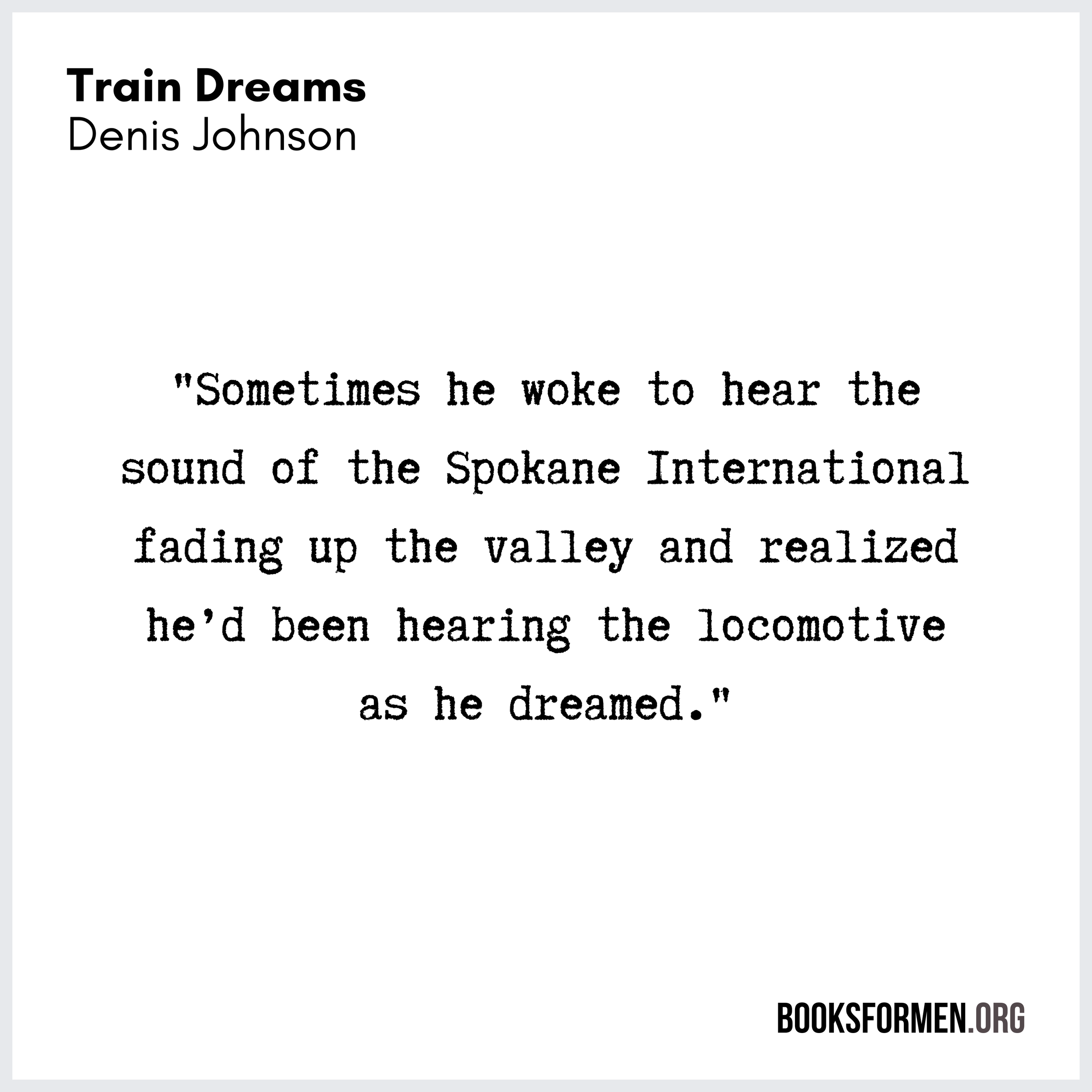
05:47 - Perhaps the most interesting juxtaposition in the entire narrative is that Granier is a man who lives in the woods, and he's deeply attuned to nature, yet he destroys nature for a living. If you think about what that means and the macro nature of that small, little aspect of this story, it is so massive and so big and forever appealing to who we are as people. The idea of trains is a well-documented metaphor in art, signifying progress, movement, journey, opportunity, choices, all of that stuff. And because the book is more interior than the movie. The title of the work, “Train Dreams”, which is also the title for the movie, works better in the novel. And this really comes to a head in chapter six, when Granier is recounting his dreams, and Denis Johnson writes, “Sometimes he woke to hear the sound of the Spokane International fading up the valley and realized he'd been here in the locomotive as he dreamed.” So there's this big passage about this in the book that really is eerie and sad.
07:03 - Delusional in a way, a coping mechanism in another. It's all there, and it's all heavy and really fortifies the title and point of the work. Overall, I would say the movie is probably easier to understand and enter. It's warmer in a way, whereas the book is colder and more devastating. Not that the movie isn't, because it follows the story pretty tightly, and what happens to Granier is sad, of course, devastating in its nature. But I guess there's just more dignity in the film, whereas the book is more focused on that idea of erasure. So people who only know the film might think that what I'm saying is impossible, but that's probably compared to other films, which I think makes this movie a strength, not compared to the book. Perhaps that's what it means to soften something for the screen or make it more cinematic. The film has a tenderness to it, especially in the ending, making it more human and soft, whereas the book is bleaker and a little more unsettling. I love the ending of the book so much that I'm going to probably spoil it right now and share the final line.
08:16 - But before I do, I will say that even though I loved the movie and it's what I actually saw first, I went and read this novella after I watched the movie because I loved the movie so much. Joel Edgerton is amazing. I do think that after reading the novella, the book is a truer version of the story's main message, and that's why I would probably recommend it over the movie. But at the same time, it's a short novella in a relatively short movie, so this is a great one for you to watch and read both and decide for yourself. So on that theme of time, just swallowing up everything. The book ends with this line that follows Granier as an old man watching this extremely evocative performance of a boy on stage, performing as a wolf. And as it concludes. The final line is, “And suddenly it all went black. And that time was gone forever.” And I loved how he encapsulated the entire narrative in a metaphoric way in that last scene. It was beautiful and just a great way to end the novella, really hammering home the point of the work, as sad and tragic as it might be.
09:44 - So there's a lot more that I could share about this story, but I think you have a pretty good understanding of what it's about. I hope you will either read it or watch it. Maybe both. Having said that, I hope you enjoyed this episode. If you did, I want to remind you to please click subscribe on whatever podcast platform you're listening to this on, because it is the best way for new listeners to find the show and, in return, inspire more men to read. If you want to connect with me, there are two ways to do so: on Instagram @DouglasVigliotti. It's the only social media that I have, or via my website, DouglasVigliotti.com. Maybe you want to check out my latest book, Aristotle for Novelists: “14 Timeless Principles on the Art of Story”. In that case, you can visit the website AristotleforNovelists.com. Last but not least, I wanted to thank you so much for listening and remind you that if you want more info on this podcast specifically, which includes signing up for that newsletter I mentioned at the top of the episode, then all you have to do is head over to the website BooksforMen.org.