#289 | Why Franz Kafka’s ‘The Metamorphosis’ Has Stood the Test of Time—Is It a Perfect Metaphor for the Human Condition?
Quick SUMMARY:
Douglas Vigliotti reviews Franz Kafka’s classic novella "The Metamorphosis," a pillar in the literary canon, exploring its themes of alienation, existentialism, and transformation. Vigliotti discusses Kafka’s legacy, his broader influence on literature and writers, and the challenges of translating the work, but cites it as the perfect embodiment of the term “Kafkaesque.” He highlights the story’s universal relevance, its emotional impact, and its overwhelming metaphor for the human condition, which only seems to be more felt as you age.
Listen to the episode:
LISTEN ON: Apple or Spotify 🎧
*Subscribe to The Books for Men Newsletter, a monthly round-up of every episode with full book and author info, all the best quotes, and newsletter-only book recommendations!
TOPICS COVERED IN the EPISODE:
Introduction & Newsletter Promo (00:09) - Host introduces the podcast, mentions "The Metamorphosis," and promotes the companion newsletter.
Kafka’s Background & Influence (01:20) - Overview of Kafka’s life, works, posthumous publications, and his influence on literature and existentialism.
Kafkaesque & Literary Legacy (02:28) - Explains the meaning of "Kafkaesque," Kafka’s impact, and his influence on later writers and filmmakers.
Summary of "The Metamorphosis" (03:41) - Brief synopsis of the novella’s plot and its famous opening line.
Translation Challenges & Interpretations (04:46) - Discussion of translation differences, ambiguity in Gregor’s transformation, and the importance of tone and theme.
Universality & Emotional Impact (06:14) - Explores the universal themes, emotional resonance, and the necessity of life experience to fully appreciate the novella.
Metaphor for Human Experience (07:43) - Analyzes Gregor’s transformation as a metaphor for human change, aging, and the inevitability of life’s hardships.
Bleakness & Kafkaesque Nature (09:09) - Reflects on the story’s bleakness, lack of explanation, and its embodiment of the Kafkaesque.
Closing Remarks & Contact Info (10:35) - Encourages listeners to read the book, subscribe, and provides contact information and book promotion.
Final Thanks & Newsletter Reminder (11:35) - Thanks listeners and reminds them about the newsletter and website for more information.
READ THE TRANSCRIPT:
Welcome back to “Books for Men”, a podcast to inspire more men to read and bring together men who do. So this week I have a classic piece of literary fiction to share with you. It is actually a novella, coming in at around 120 pages or so, depending on which translation you read. It was originally published in 1915, but the edition that I read came out in 2014. It was a newer translation done by Susan Bernofsky. And of course, the title of this book is “The Metamorphosis” by Franz Kafka. You probably have heard the name. He's a very well-known figure in literature, and I will share more about that, along with some of my huge takeaways from this book, as well as things that I think you will appreciate and get out of it by reading. But before I go any further, I wanted to quickly remind any new listeners out there of the companion newsletter that goes out once a month, rounding up all of the episodes from that month, complete with full book and author information, all of my favorite quotes, episode summaries, and additional book recommendations.
01:20 - So if that sounds like something that you are interested in, or perhaps you just want to sign up, then all you have to do is head over to the website BooksforMen.org. All right. So now let me pivot back to the reason why you are here. “The Metamorphosis” by Franz Kafka. As always, I like to start with the author. So Kafka was a Jewish Czech writer born in Prague, whose native language was German. And the reason why I share that, of course, is because his work was all published in German. Sadly, he died at the young age of 40. Basically, he got sick and then died of what they say was starvation. He was the writer of three novels: “The Castle”, “The Trial”, and “Amerika”. The book that I am sharing with you today, as I previously mentioned, is more of a novella. He published a lot of shorter work, so short stories, essays, all that stuff, many of which were actually published posthumously against his will. Or so it's said that his friend Max Brod was told by Kafka to burn any of the works in progress, and he ended up publishing them anyway.
02:28 - “The Metamorphosis” is probably one of the most widely recognized pieces of literature in the world. It's really stood the test of time, and I will get into all of that in just a moment. And perhaps because of this, along with some other factors, of course, Kafka is probably one of the more highly regarded writers of the 20th century, which is always interesting to me because he was basically an insurance clerk who wrote fiction in his spare time. I mean, anytime your name becomes a word recognized in the dictionary, as in Kafkaesque. You may have heard that before, as a way to describe something that is oppressive, illogical, bureaucratic, isolationist in a way bizarre, absurd, all things that his literature is known for. Then, you know you've made an impact. So this is beyond any superficial outcome, like bestseller or anything of that nature. It comes down to influence. And he was basically the precursor to the whole existentialism movement, influencing writers and filmmakers like Albert Camus, who I've featured on this podcast.
03:41 - I will link that episode up in the show notes. Jean-Paul Sartre. And in a slight tangent, he actually has one of my favorite quotes of all time. And it's, “He who jumps into the void owes no explanation to those who stand and watch.” I love that quote. And then, of course, there were the later surrealist writers like Gabriel Garcia Marquez and Haruki Murakami, who I've also featured on this podcast. And I'll link that episode up in the show notes or maybe episodes. Actually, I think he's been on twice, one of the rare writers, but Kafka, his writing is deadpan. It's frank, challenging, but not in syntax, more so in its themes. And I think this is probably a good place for me to turn to the work at hand, “The Metamorphosis”. In short, the story is about a traveling salesman who awakens one day to find out that he has been transformed into a giant insect. So there's probably not a more famous opening line in literature than the one that this book starts with. And that’s…
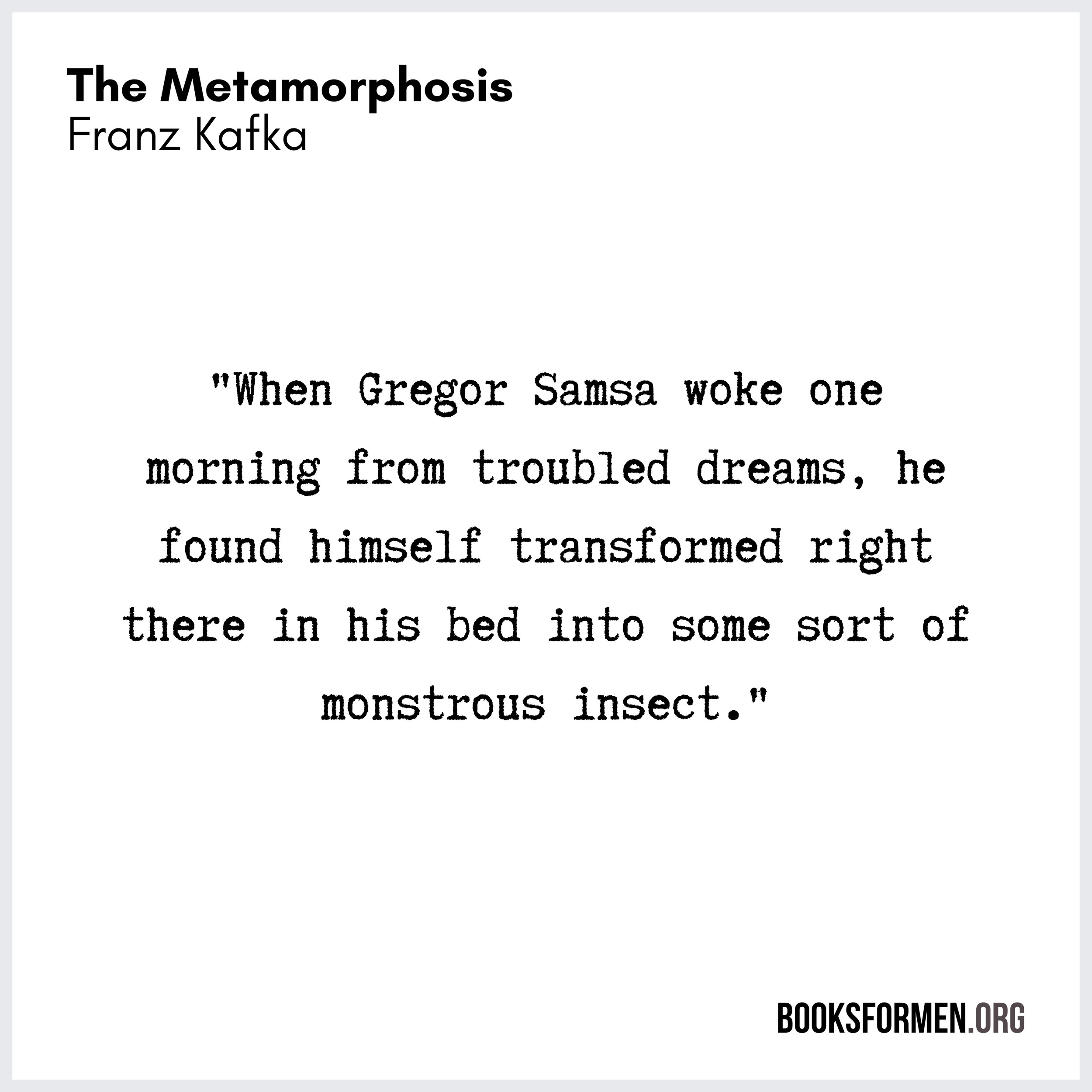
04:47 – “When Gregor Samsa woke one morning from troubled dreams. He found himself transformed right there in his bed into some sort of monstrous insect.” The story, as I alluded to before, has been translated a few times over the years. In the copy I have is the latest, and that was done again in 2014 by Susan Bernofsky. What Gregor transforms into is up for debate in a lot of these translations. Some say monster-like vermin. Others go with straight vermin. Others say giant bug or cockroach. And it's interesting to think about how one of the most famous lines in literary history cannot even be agreed upon, really, and some can't even agree upon the title of the work. So one translator, Mark Harman, prefers “The Metamorphosis”, the transformation. This is one of the challenges of translating foreign fiction, especially dated foreign fiction, because there aren't exact word replacements for certain things. Now, this is all to say that I don't think it matters because the theme and tone and what the story is actually showing the reader is the more important piece, and in some sense, because German didn't have an exact translation for that opening line or even the title, it makes what Gregor turns into a bit more vague.
06:14 - And in my opinion, this is actually probably more effective. Or it's like Bernofsky insists in the afterword of the copy that I read, she says, “In my translation, Gregor is transformed into ‘some sort of monstrous insect’, with ‘some sort of’ added to blue the borders of the somewhat too specific insect. I think Kafka wanted us to see Gregor's new body and condition with the same hazy focus with which Gregor himself discovers them.” So this is interesting, right? Because what we have is Bernofsky making an interpretation of what Kafka actually meant, rather than giving you a word-for-word. Translation. This is always something that, when you're reading translated work, and why translations are different and important to understand, is because some are quote-unquote better than others. Some take more liberty than others; some go word-for-word and leave that up to the reader. This is all up for debate, of course, in the world of translation and literature. Like, what is your take on the matter? In any case, in this instance, what happens to Gregor could be read as so widely universal that it appeals to everyone, and the book is often read in academic settings because of this.
07:43 - But what I find strange is that I think to truly grasp the work, it requires some life be lived. Now, this is not to say that you won't understand it. That's easy. But I mean to really feel it? Like you need time for your life to slowly morph into the undeniable. And this happens to everyone at some point, for you to really feel what the work is saying about humanity and the human condition. And I just think it's really hard for the average young person to grasp that, again, not to understand, but to really feel the emotional aspect of what this work is saying. It's like David Cronenberg writes in the introduction of the translation that I read. He says, “I woke up one morning recently to discover that I was a seventy-year-old man. Is this different from what happened to Gregor Samsa in ‘The Metamorphosis’?” And then he goes on to say, “The source of the transformation is the same, I argue: we have both awakened to a forced awareness of what we really are, and that awareness is profound and irreversible. In each case, the delusion soon proves to be a new mandatory reality. And life does not continue as it did.
09:16 - And I just think if you look at Gregor through the lens as a metaphor for what happens to us as humans, it's downright disturbing. And if you've lived a little bit of life and you had to endure some of these undeniable truths as you seemingly woke up one morning to realize the unchanged ability of what has happened to you in your life and how that affects it moving forward and forever. But again, that disturbing nature is the point. There is never an explanation in “The Metamorphosis” for Gregor's transformation. It just happens. Just like life and misfortunes and things in life just happen, and people are left only to react and deal with the consequences and ultimately move on, because life goes on. And this doesn't even get into the actions and thoughts of our protagonist, Gregor Samsa, and the things that have set up this story, and makes it even more sad in the way that it ends.
10:35 - It's bleak, and, dare I say it, probably the perfect embodiment of something that is Kafkaesque. All right, so I think I've done enough with this episode. You understand it. You may have read this book before in your life, through academics or what have you, but if not, this is a reminder to pick it up, check it out, because it is a pillar in the canon of literature. Having said that, I hope you enjoyed this episode. And if you did, please remember to click subscribe on whatever podcast platform you are listening to this on, because it is the best way for new listeners to find the show and, in return, inspire more men to read. If you want to reach out to me, there are two ways to do so: either on Instagram @DouglasVigliotti. It's the only social media that I have, or via my website, DouglasVigliotti.com. Maybe you want to check out my latest book, “Aristotle for Novelists: 14 Timeless Principles on the Art of Story”. In that case, head over to AristotleforNovelists.com. Last but not least, I wanted to thank you so much for listening and remind you that if you want more information on this podcast specifically, which includes signing up for that newsletter I mentioned at the top of the episode, then all you have to do is visit the website BooksforMen.org.