#274 | Juilliard Dropout to Jazz Legend: What Miles Davis Teaches Men (and Women) About Tenacity, Creativity, and Life
Quick SUMMARY:
Douglas Vigliotti reviews “Miles”, the autobiography of jazz legend Miles Davis. Vigliotti explores Davis’s life, musical legacy, and influence on jazz, highlighting key albums like “Birth of the Cool” and “Kind of Blue”, and sharing seven insightful quotes from Davis. He also briefly discusses the biopic “Miles Ahead”, what makes it different, and why he recommends it as a companion watch. As always, the episode aims to inspire men to read and foster conversations about great books.
Listen to the episode:
LISTEN ON: Apple or Spotify 🎧
*Subscribe to The Books for Men Newsletter, a monthly round-up of every episode with full book and author info, all the best quotes, and newsletter-only book recommendations!
TOPICS COVERED IN the EPISODE:
Introduction & Newsletter Promo (00:09) - Host introduces the podcast, the book "Miles," and promotes the companion newsletter.
Miles Davis: Background and Influence (01:13) - Overview of Miles Davis’s career, personality, collaborations, and impact on jazz.
Famous Albums and Artistic Longevity (02:23) - Discussion of "Birth of the Cool," "Kind of Blue," and "Bitches Brew," highlighting Davis’s evolving artistry.
Spontaneity and Artistic Process (03:33) - Reflection on spontaneity, over-editing, and emotional resonance in art, with a Picasso quote.
Biopic "Miles Ahead" Mention (04:47) - Brief review of the "Miles Ahead" biopic starring Don Cheadle and its creative approach.
Book Overview and Hardships (05:59) - Description of the autobiography’s style, co-author, and coverage of Davis’s struggles and opinions.
7 Miles Davis Quotes and Creative Lessons (06:58) - Host shares and explains seven favorite Miles Davis quotes, relating them to creativity and life.
Closing Remarks and Promotions (10:31) - Host wraps up, promotes his book, social media, and encourages newsletter sign-up.
READ THE TRANSCRIPT:
Welcome back to “Books for Men”, a podcast to inspire more men to read and bring together men who do so. This week, I have a piece of nonfiction to share with you. It is an autobiography titled “Miles” by Miles Davis. It should be self-evident what this book is about. It clocks in at around 450 pages or so and came out in 1989. So I will share a lot more about the book, the author, the life of the author. And I will do something a little different with this episode, something I've done in the past, and share seven of my favorite Miles Davis quotes. So they're not necessarily from this book, but they are quotes that I really like. And I will tell you why I like them, along with a lot of other cool tidbits. But before I do any of that, I wanted to remind you of the companion newsletter, which is just a once-a-month email, rounding up all of the episodes from that month, complete with episode summaries, all of the author and book information, all of my favorite quotes, as well as additional book recommendations. So if that sounds like something that you are interested in, all you have to do is head over to the website BooksforMen.org.
01:21 - Okay, so now let me pivot back to the focal point of today's episode, Miles Davis. He's probably one of the most acclaimed and celebrated jazz musicians of the 20th century. He primarily played the trumpet, but his musicianship is only the tip of the iceberg for what made Miles Davis so influential. It was really his daring, boisterous personality that pushed the boundaries and cracked the jazz world wide open. So he was a Juilliard dropout, which is notable because I think it says something about his personality and style, which this book will definitely illustrate, but he often collaborated with other greats like John Coltrane, Herbie Hancock, Bill Evans, Tony Williams, and a slew of others. His career spanned close to five decades, and he probably released around 60 albums or so, not including his 30 to 40 live albums or the many, many compilations. His most famous works are. “Birth of the Cool”, which was in 1950, is a laid-back style that shifted jazz music.
02:23 – “Kind of Blue”—most consider this his masterpiece, and some consider it the greatest jazz album of all time. That came out in 1959, and it's an album that I've listened to more than once while walking around Manhattan. Something about it is very mesmerizing and grabbing. And then there was “Bitches Brew”, which came out in 1970, a double album that fuses many styles of music together. I think the interesting part about all of these notable albums is that each one is approximately a decade apart, which says something about his tenacity and longevity as an artist. The “Kind of Blue” inception story is sort of legendary as being recorded in only two sessions, and the whole album was conceived just hours before those sessions. It's the type of story that reminds us of so many things, the power of spontaneity being probably the most prominent, something that jazz is known for in general, but it's also a reminder that great quality is not necessarily indicative of how much time you spend on something. And I think it's just so easy to delude ourselves into thinking that if we spend more time on something, it's going to actually get better.
03:33 - That may or may not be true. I can speak from my own experience. Sometimes when I over-edit something, it loses the essence of what it actually is and turns into something completely different. Now, some might consider that better, some might consider that worse, but it's definitely different. And sometimes the more polished that you make something or the more tightly you make something fit together. While it might feel like a technical achievement. It loses the probably more important quality of emotional resonance, which is, in my opinion, what most consumers and I put myself in this bucket as a consumer, remember about any piece of art. I often tell people that when you're in the presence of another person, people don't care what you say, what you do. They just care about how you make them feel. And I think that the same could be said for any piece of art. Miles Davis his work definitely makes you feel something very visceral, and just tying a bow on this idea of spontaneity, not over-editing, great quality, not being necessarily indicative of how much time you spend on something.
04:47 - It reminds me of a Pablo Picasso quote that I really just adore, and he says, “Everything interesting in art happens right at the start. Once you're past the beginning, you're already at the end.” So I won't harp on that. But I did want to quickly mention before I turn to this autobiography, more specifically in those quotes that I mentioned at the top of the episode, that there is a biopic on Miles Davis's life called “Miles Ahead”, starring Don Cheadle, which came out in 2015. That is probably one of my favorite biopics of all time, and that's because it does something a little different. It openly admits that it is not real. It's imaginative in a pretty big way. So there was a time period when Miles Davis, in the 1970s, went silent and held himself back from the public eye. And this is a story of what happened to Miles Davis during that time period when he was silent. So it's very imaginative, very creative, and hence very enjoyable. All right. So, as for this book specifically, obviously, it's an autobiography that details Miles Davis's life, written in conjunction with Quincy Troupe, a poet, editor, and journalist who did a marvelous job, I would say, capturing the iconic voice of Miles Davis.
05:59 - It’s voicey, irreverent, fun, easy to read. It reminds me a lot of the Keith Richards autobiography, “Life”, which I shared on this podcast a couple of years ago, and I will link that up in the show notes. Also like that one. This book includes Miles Davis's many hardships, which include his struggle with addiction, his relationships, the toll his artistry in addiction took on them, as well as his thoughts and opinions on a range of artistic topics, from other musicians to styles to ideas on craft. But rather than going to each one, I thought it would be fun to share some of my favorite Miles Davis quotes. And a quick tidbit on why not all come from this book, but they are all worthy of sharing. So let's start with quote number one. “I'll play it first and tell you what it is later.” So many reasons why I love this quote. Obviously, it goes hand in hand with that whole idea of spontaneity, but it also hinges on the idea of not allowing the audience or readers.
06:58 - If you are a writer, to dictate what you are playing or writing, just let the cards fall as they may. The business side of art probably won't like this too much, but I think that from a purely creative standpoint, it's great advice. Quote number two. “If you hit a wrong note, it's the next note that you play that determines if it's good or bad.” What an amazing quote, because it's the power of not looking backwards. And if you make a mistake, the next action is the thing that's going to determine how bad that mistake actually was. So if you compliment it in the right way, then it looks like it was meant to be. And there all along, and I think great musicians, and definitely jazz musicians, do this extremely well. But it's something that, as regular civilians, we can learn from. Quote number three. “Don't play what's there, play what's not there.” If you've listened to this podcast enough, you know I love the idea of what's not there being more important than what is.
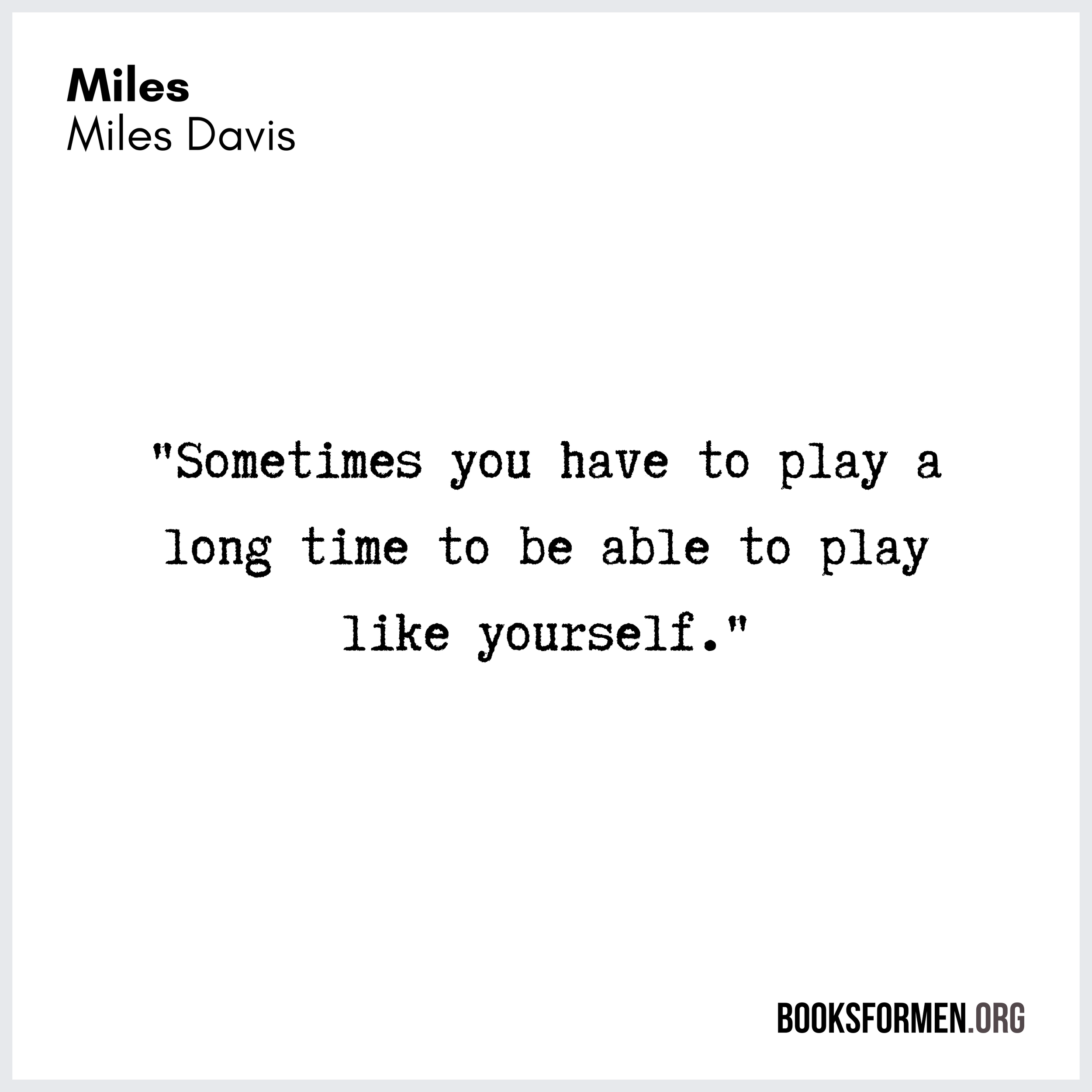
08:07 - And this is a derivative of that idea. It's not the same thing because ultimately, you're bringing what's not there into the there. According to this quote, it nonetheless emphasizes focusing on what isn't there. A Sherlock Holmes type of mentality, as opposed to what is there. And I think that that's just a really powerful idea. Quote number four. “Sometimes you have to play a long time to be able to play like yourself.” To me, this is just so true because when you first start creating anything, you're imitating people because that's what's inspiring you. More times than not to do that thing. And it takes time for your true voice and your true ideas and your true creativity to come through. And it also takes time for what Ira Glass calls the Taste-Talent Gap to merge, meaning the good taste that brought you into whatever you're doing creatively. It takes time for your talent to match that taste. Quote number five actually complements quote number three really well. So well that I wish I shared it as quote number four.
09:15 - But it goes: “It's not the notes you play, it's the notes you don't play.” Again, this is emphasizing you to focus on what isn't there. It's really a counterintuitive approach to creativity, but it's something that I've shared quite a bit on this podcast from a literary perspective, whether it's Ernest Hemingway or Raymond Carver, Amy Hempel or even Justin Torres’s, “We the Animals”, a book that I shared earlier this year, quote number six is, “If you understood everything I said, you'd be me.” It's the power of perspective, having a unique angle on something and perhaps even more importantly, the courage to be misunderstood, to be disliked in some ways, because we all come from different backgrounds and have a different worldview, and hence the way we see something and how we think about something might be vastly different and you might not be able to clearly understand. But that's okay, because again, the objective isn't to make you understand, it's to make you feel something. At least if you're an artist in the last quote stands on its own; it should be self-evident that it complements everything else that I've been talking about in this episode.
10:31 - And Miles Davis says: “Anybody can play. The note is only 20%. The attitude of the motherfucker who plays it is the 80%.” Bold—but just like Miles Davis is. So I hope you enjoyed this episode. If you did, you'll probably enjoy the book, and I want to remind you to please click subscribe on whatever podcast platform you're listening to this on, because it is the best way for new listeners to find the show and hence inspire more men to read. If you'd like to connect with me, there are two ways to do so: on Instagram @DouglasVigliotti. It's the only social media that I have, or via my website: DouglasVigliotti.com. I do have a new book out. It is titled “Aristotle for Novelists: 14 Timeless Principles on the Art of Story”. If that sounds like something that you're interested in, you could visit the website AristotleforNovelists.com. Last but not least, I wanted to thank you so much for listening and remind you that if you want more information on this podcast specifically, which includes signing up for that newsletter I mentioned at the top of the episode, then all you have to do is visit the website BooksforMen.org.