#275 | What Does the Classic Literary Novel ‘Gulliver’s Travels’ Have in Common with Rock and Roll Legend Bruce Springsteen?
Quick SUMMARY:
Douglas Vigliotti explores Jonathan Swift’s classic "Gulliver’s Travels." He discusses Swift’s background, his mastery of satire, and the novel’s four-part structure, highlighting its sharp social and political commentary. Vigliotti explains how the book’s original, serious themes are often misunderstood as mere children’s fantasy today. He encourages listeners to tackle the challenging prose for its rewarding insights and connects the novel’s enduring relevance to modern society.
Listen to the episode:
LISTEN ON: Apple or Spotify 🎧
*Subscribe to The Books for Men Newsletter, a monthly round-up of every episode with full book and author info, all the best quotes, and newsletter-only book recommendations!
TOPICS COVERED IN the EPISODE:
Introduction to the Episode (00:09) - Douglas introduces the podcast, its mission, and the featured book, "Gulliver's Travels" by Jonathan Swift.
About Jonathan Swift (01:17) - Background on Swift, his era, his satirical style, and other notable works.
Overview of "Gulliver's Travels" (02:13) - Summary of the novel’s structure, main character, and its satirical nature.
Part One: Lilliput (03:23) - Discussion of Gulliver’s visit to Lilliput, the land of little people, and its metaphorical meaning.
Part Two: Brobdingnag (04:45) - Gulliver’s journey to the land of giants, exploring the theme of perspective and individual insignificance.
Part Three: Laputa (05:40) - Gulliver’s visit to Laputa, a floating city of intellectuals, satirizing impractical knowledge and scientific reasoning.
Part Four: The Houyhnhnms (06:09) - Gulliver’s final journey to the land of rational horses and the critique of pure rationality.
Modern Relevance and Personal Reflection (07:40) - Douglas reflects on the book’s relevance today and his own thoughts on reason versus passion.
Misinterpretation as a Children’s Story (08:59) - Explains how "Gulliver’s Travels" is often mistaken for a children’s story and compares it to "Born in the USA."
Clarifying the Book’s True Nature (10:07) - Emphasizes the book’s deeper meaning and the importance of understanding its true message.
Final Thoughts and Quote (10:50) - Encourages readers to tackle the book, shares a quote, and wraps up the discussion.
Outro and Contact Information (11:13) - Reminders to subscribe, connect on Instagram or the website, and information about Douglas’s new book.
READ THE TRANSCRIPT:
Welcome back to “Books for Men”, a podcast to inspire more men to read and bring together men who do. So this week I have a classic piece of literary fiction to share with you. It clocks in at around 300 pages or so, but that will change quite a bit depending on which edition or reprint version you pick up. It is titled “Gulliver's Travels” by Jonathan Swift. I'm sure you've heard the title before, but it originally came out in 1726, so a very long time ago, and I'm going to share a lot more about that. The book, the author, and the reason I am sharing this book with you. There are two very big reasons. But before I do any of that, I did want to quickly remind you about the companion newsletter that goes with this podcast. And that's just a once-a-month email that rounds up all of the episodes from that month, complete with full book and author information, episode summaries, all my favorite quotes, and additional book recommendations. So if that sounds like something that you're interested in, or maybe you just want to sign up, then all you have to do is visit the website Books for Men.
01:17 - So, Jonathan Swift, who is he? Well, he's a writer, of course. It's hard to say how many books he wrote. He was a writer of novels, essays, poems, what they call it at the time, pamphlets. So we're talking about Ireland 300 years ago. He was born in Dublin in 1667. And when the book I am sharing with you was originally published in 1726. Just to put this in perspective, the US hadn't even been founded yet in 1776, of course, and the US Constitution was written in 1787. So we're talking about a good 50-60 years earlier. Not that this book had anything to do with that, but just again, putting it into context for you. It was a very long time ago. Swift himself was regarded as one of the major satirists of his day, a subgenre or style, depending on your definition of it. Of course, that is no stranger to this podcast. I love satire, and I've actually featured quite a few books most recently.
02:13 - Obviously, Elmore Leonard's “Get Shorty” just a week ago, and I will link that up in the show notes. Aside from the book that I'm sharing with you today, “Gulliver's Travels”, which is Swift's most famous work, some of his other notable works were “A Tale of Tub” and the essay “A Modest Proposal”, all featuring his quintessential irony, parody, dark humor, and exaggeration to criticize politics and society. So this kind of leads me back to “Gulliver's Travels”, a book that many consider to be one of the greatest novels of all time. And I will say that it is a very tough read. The language takes a bit of getting used to, as it was written many, many years ago. But before I dive into all of that, let me first share some more about what the book actually is, because I think that there may be a little confusion or misunderstanding of what the story is about. Especially if you're going off of modern-day adaptations. But I am getting ahead of myself. So what is the story? Well, it's a novel that's told in four parts about our protagonist, Lemuel Gulliver, an Englishman who leaves home traveling to all of these strange foreign lands.
03:23 - In the novel itself is a commentary on each of these lands, what he saw, what he learned, and what happened in each place. But also, it's a thematic representation of the unflattering and troubling nature of society at large. In part one, we see Gulliver head to Lilliput, a land of little people who are only six inches tall. And on its face, this is absurd, of course, but so is the entire novel, really. And that absurdity is part of the satire element of his work. But in this part is really a lesson in the pettiness of human beings and our pride in our triviality. As you see, these people from Lily put squabbles over politics and things like that, and metaphorically, this represents our seemingly insignificance as human beings in the grand scheme of things. And of course, the physical size of these people is supposed to draw a magnifying glass on that idea. Part two in Gulliver's voyage, and I'm going to mispronounce this because it's a hard word to say, and when I was reading it, I just called it “Brod.”
04:45 - But it's Brobdingnag, a land of giants, and this cleverly reverses the physical size dynamics, which probably above everything, showcases the power of perspective. So when he was in Lilliput, he was the biggest person; he had a different way of looking at something than when he was the smallest person in this new land. It also represents our individual insignificance. So while the first story is more about our collective insignificance in the broader scheme, this speaks more to our individual insignificance. So it's really a juxtaposition. And then in part three, Gulliver goes to Laputa, a floating city inhabited by intellectuals. He does travel to some other minor places along the way, but it's mainly about this place, Laputa, which sits high above, throwing stones down at anyone who tries to invade or criticize. This is a mocking of scientific reasoning, but probably more importantly, at the expense of common sense, as most of the inhabitants are obsessed with what I would consider impractical but self-important knowledge. And then in Gulliver's final journey, which is part four, we see him travel to the land of Houyhnhnms.
06:09 - And I know that that was a mouthful. But again, it's a tough word to pronounce in my reading. I would just call it “Houy”. And these are talking horses. Who are these purely rational beings, I guess. And they are the rulers of yahoos, which are these deformed human beings who are obsessed with greed and lust and all of these things that are supposed to represent the animalistic and basic instincts of humanity. And even though the horses rule the people, Swift is further criticizing pure rationality, mostly because it shows that if you are focused on just reason, mathematical truth, logic, the world can become devoid of passion or compassion and empathy. And that's what this final story shows. And now I won't ruin the ending. But ultimately, Gulliver becomes disillusioned with this extreme version of, I guess, the enlightenment in what that promised to us as a society, and proof that anything can go to the extreme. Eerily, I can't help but think of where we are now as a society in present-day 2025.
07:40 - So much so that I actually wrote a pop-up essay for Instagram following a visit to the Met recently. And in that, I talk specifically about this because I feel like as we rely more on science, math, logic, reason, all things, by the way, that are great, we also are sacrificing something else. And perhaps it's the more important aspect of living a fulfilling, healthy life. Of course, this is up for interpretation, but it is making me want to now share this with you on the podcast. So maybe I will do that in the near future. So that is one big reason why I wanted to share this. But the second reason is that, at least in a modern sense, we have this idea of “Gulliver's Travels” being a children's story because of the adaptations. And I think that when you look at that in a bubble, it shows the power of what happens as time washes things away and morphs them into whatever it wants them to be. Meaning clearly, this story is so heavy and so big and so grand and so impressive for 1726.
08:59 - I mean, Jonathan Swift was so ahead of his time as an artist, and he was criticizing the English government at the time and the religion of the time. But why I bring this up is because what it's morphed into is this idea of “Gulliver's Travels” being this childlike story of fun and adventure and all of these things, which it clearly isn't. It's almost the exact opposite, in a way. It's sort of like the “Born in the USA” of stories. So, “Born in the USA” is a Bruce Springsteen song. Often people think of it as this very patriotic chant of USA like dot, dot, dot, dot, but it's really the exact opposite, where he's making a sharp critique on the injustices and the hypocrisy of the United States sending people all over the war and all of these different things. And I don't know if this is the reason why, because I don't think he's ever said it, but he doesn't play the song live anymore. And I think that that's interesting, especially considering it's one of his biggest songs of all time.
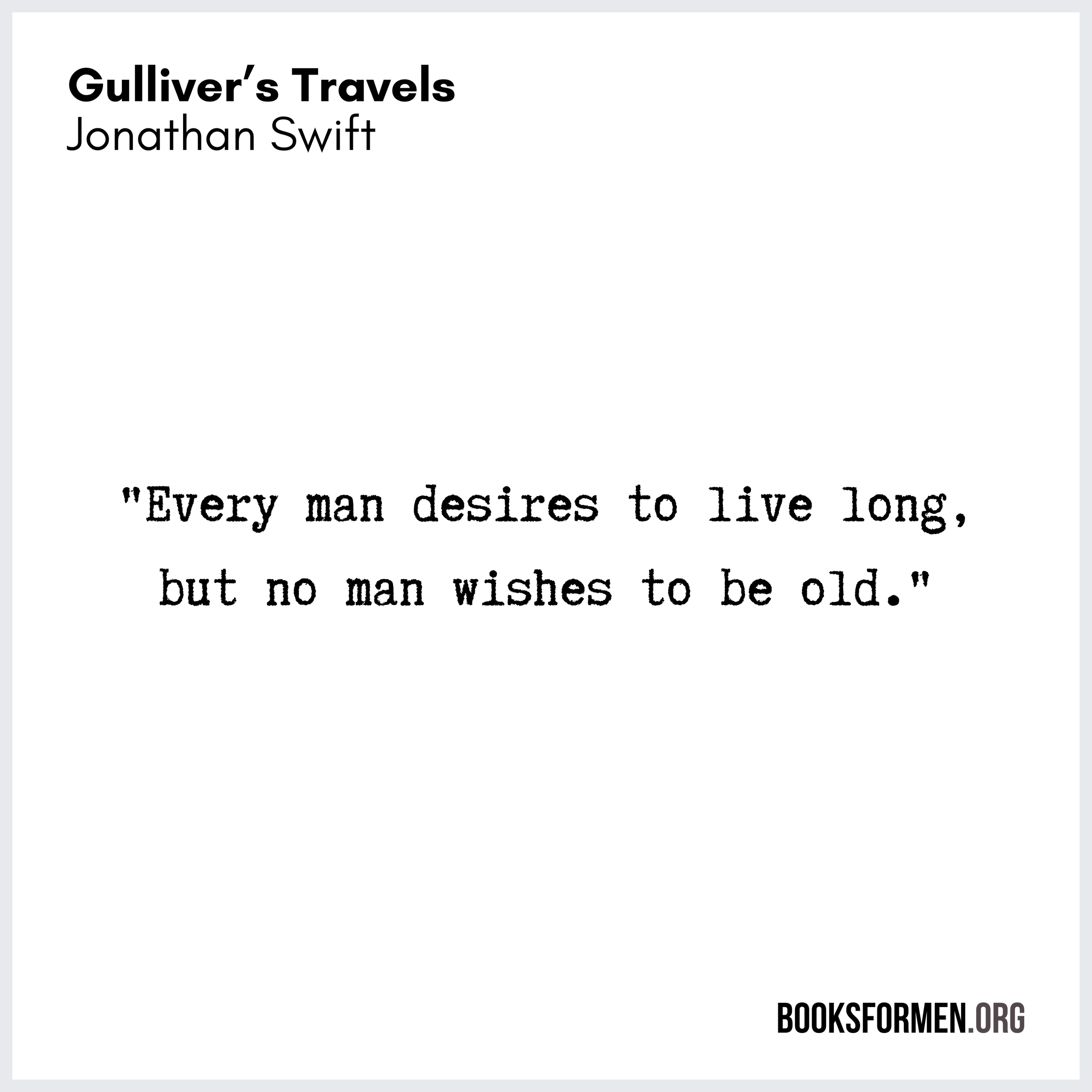
10:07 - Having said that, I only raise it to say “Gulliver's Travels” is sort of like that, and it's something that has a really powerful metaphor and meaning to it that has changed into something that it isn't. And I thought by sharing this with you, it would put a spotlight on that macro idea, even more so than, say, the sharp criticism of ideas that “Gulliver's Travels” offers to us. Okay, so I think I've jabber on long enough here, and you get what the book is about again. I will just say it is a tough read, so anyone who does try to tackle it, be prepared to learn a very old syntax in order to get through it. Having said that, I do think it's worth it, especially for those who like a literary challenge and definitely people who enjoy satire or metaphor. This definitely promises that. And you may have noticed that I didn't share any quotes from the book, so I will end with one here. And Swift writes: “Every man desires to live long, but no man wishes to be old.”
11:13 - On that note, if you enjoyed this episode, I want to remind you to please click subscribe on whatever podcast platform you're listening to this on, because it is the best way for new listeners to find the show and, in return, inspire more men to read. If you want to connect with me, there are two ways to do so: on Instagram @DouglasVigliotti. It's the only social media that I have or via my website DouglasVigliotti.com. I do have a new book out. It is titled “Aristotle for Novelists: 14 Timeless Principles on the Art of Story”. If that sounds like something that you are interested in, then you can visit the website AristotleforNovelists.com. Last but not least, I wanted to thank you so much for listening and remind you that if you want more information on this podcast specifically, which includes signing up for that newsletter I mentioned at the top of the episode, then all you have to do is head over to the website BooksforMen.org.