#287 | How David Szalay’s ‘Flesh’ Challenges Men to Confront Their Emotional Realities Before They Are Destroyed by Them
Quick SUMMARY:
Douglas Vigliotti discusses “Flesh” by David Szalay, a Booker Prize-winning novel published in 2025. Vigliotti explores Szalay’s minimalistic, bleak, emotionally detached prose and the story of Istvan, a man shaped by adolescent trauma. He highlights the book’s themes of male alienation, stunted emotional development, class, and power, praising its unique style and usage of white space on the page. Vigliotti shares personal reflections and emphasizes the book's resonance with sad-but-true elements of the male experience.
Listen to the episode:
LISTEN ON: Apple or Spotify 🎧
*Subscribe to The Books for Men Newsletter, a monthly round-up of every episode with full book and author info, all the best quotes, and newsletter-only book recommendations!
TOPICS COVERED IN the EPISODE:
Introduction to the Podcast and Book (00:09) - Douglas introduces "Books for Men," the episode's focus on "Flesh" by David Szalay, and mentions the companion newsletter.
About the Author and Book's Background (01:13) - Douglas discusses David Szalay's previous works, the Booker Prize, and why "Flesh" stands out.
Thoughts on Literary Hype and Unique Style (02:12) - He reflects on book hype, what makes "Flesh" exceptional, and his admiration for its unique, stylized prose.
Summary of the Story and Main Character (03:19) - Douglas outlines the plot, Esteban's traumatic adolescence, and the book's bleak, minimalistic tone.
Discussion of Writing Style and Minimalism (04:32) - He analyzes Szalay's distinctive prose, use of space, and how minimalism shapes the reader's experience.
Examples of Prose and Emotional Impact (05:47) - Douglas shares specific examples from the book, highlighting the emotional weight and precision of the writing.
Themes: Alienation, Trauma, and Male Experience (07:03) - He explores the book's themes: male alienation, emotional development, and the long-term effects of trauma.
Broader Themes: Classism and Power (08:26) - Douglas discusses class, power, and how childhood experiences shape adult behavior, regardless of status.
Favorite Quote and Final Reflections (09:52) - He shares a favorite quote, summarizes the book's impact, and encourages listeners to read it.
Closing Remarks and Contact Information (10:55) - Douglas wraps up, promotes his own book, and provides ways to connect or learn more about the podcast.
READ THE TRANSCRIPT:
Welcome back to Books for Men, a podcast to inspire more men to read and bring together men who do. So this week, I have a piece of literary fiction to share with you. Comes in at around 350 pages or so. It came out in 2025, and it is titled “Flesh” by David Szalay. I hope I'm pronouncing that right. He is Hungarian in the phonetics of his last name, which is a little challenging or different from what I am used to. It is spelled s z, a l, a y. And of course, I will share a lot more about this book—what I took away from it. There was a lot to admire. I really, really liked this book, but before I get into any of that, I did want to quickly remind any new listeners out there of the companion newsletter that goes with this podcast. And that's just a once-a-month email that rounds up all of the episodes from that month, complete with full book and author information, episode summaries, all of my favorite quotes, and additional book recommendations.
01:13 - So if that sounds like something that you are interested in, or perhaps you are ready to sign up, then all you have to do is head over to the website BooksforMen.org. All right, so now let's give it back to the work at hand. And as always, I like to first start with the author. So before reading this book, I didn't know much about the author. He's authored what looks to be six previous novels, but it appears that this one, “Flesh”, is his first that features a single protagonist, so his other works appear to be more episodic in nature or nonlinear, and they feature slightly or only thematically connected stories. Obviously, I have not read anything by him other than this book, which is why I am hesitating a little bit to make sweeping claims. But this one was a Booker Prize winner, and in some sense that's what led me to it. It's gotten a lot of buzz over the last year or so in the literary world, and in my opinion, this is for good reason.
02:12 - I can't say this is always the case for me. There are a good deal of quote-unquote hyped books that I believe are popular for secondary reasons, meaning their praise is not based on quality or novelty or execution, so to speak. The reason I don't share that all the time is I still have respect for the authors, obviously, and the creative process and the challenge of writing a book in general. So, as they say, I let sleeping dogs lie. However, as in this case, when a book does live up to the hype for me, I find it necessary to sing its phrases. I was jealous, I would say, after reading this book. That's how much I liked it. It usually happens, for me, when I read a story that is told in a unique style that I really admire. So even if a story is told well, but it's told in what I perceive to be cookie-cutter craft. Then I don't usually get that feeling, but when it's really stylized in this book is heavily stylized.
03:19 - Then there's something to really admire, I would say, with the work, or it's really grabbing in that way. I am getting a bit ahead of myself. So first, let me tell you something about the story, because I do have a lot to say. So on that note, the story is really about one man's life, an emotionally detached adult whose adolescence was derailed by rejection in a sexual relationship with this 40-something-year-old woman, a neighbor, and that resulted in the accidental death of her husband. And Esteban spends time in juvenile detention. And in many ways, this traumatic experience is the catalyst for how his life unfolds. And the story is really about what happens after and because of this early childhood experience, more so than it is about its juicy setup. There's nothing actually juicy about this book. It's bleak and deadpan and radically minimalistic. And as I began to mention earlier, it's heavily stylized, so most people think when they hear the word style, they think flash and even fashion, like the word fashion.
04:32 - Like, oh, that person is stylish. But I mean it in the literal sense of the word, as in a manner of doing something so you could have a unique style, or a common style. There are all different types of style. And when you're talking about writing, style is usually the word that people use to describe the prose. And his style of writing is very unique. At least in this book, and even the formatting is very unique and stylish. The way Salazar uses space on the page allows you to really grapple with what's happening with our otherwise sad protagonist, Istvan. It's not just a lesson in minimalism, although it is that, it's a lesson in the geometry of how words are displayed on a page. At least that's what I felt when I was reading it. He leaves so much out intentionally, and this place is a large emphasis on the reader to pick up, quote unquote, what he's putting down. Like, even just like he'll flippantly say, “When the lockdown started…” Now you have to determine from that whether they were in a lockdown or during that period of time.
05:47 - He's not going into elaborate detail to explain that that's the time period that it's in. That's just one very small example of what I am talking about. At the same time, you're never totally confused, and you're really immersed in the story. The literal space on the page makes things feel more weighty and even longer. To a degree. It really gives this journey-like feel to the story. I even love at the beginning how he uses objects like this Hungarian food, somloi galuska, I think it's called, as part of the sparse description of a scene with that significantly older woman. He is always queuing it with this food, and it makes it just feel so sad and barren. But you don't need this overdescription. It's just the fact that this is how he's describing the scene with this barren food, some somloi galuska. He'll also write things like, and this is a little touchy, but when the woman is going down on him, he has this quote where he says: “He's looking at the top of her head, at the roots of her hair, where the blonde he now sees is slightly mixed with gray.”
07:03 - And that's just the entire sentence in the entire paragraph. And when you're reading that in context, you're just so, I don't know if mortified is the right word, but you feel so bad for the situation that is occurring. The words are so precise, but at the same time heavy. Like, how could this person be noticing this? It's a really unique way to show the bleakness of the interiority of our protagonist, as they are going through this very traumatic aspect of their life. I know you've heard me say this before, but it's a great example, and this book in general is a great example of quote unquote, less being more. The fact that he maintains this realism and sparsity throughout the story, despite its length and time that it covers. So an entire man's life, to me, was just such a feat to just sustain it. And it's a great example of perhaps alienation in the male experience and how specifically sexual experiences make it hard to develop emotionally in relationships. Estevan never shakes the kid that's inside of them, and this manifests in a multitude of ways that are unhealthy for him as he grows older—anger, violence, criminal activity in some sense.
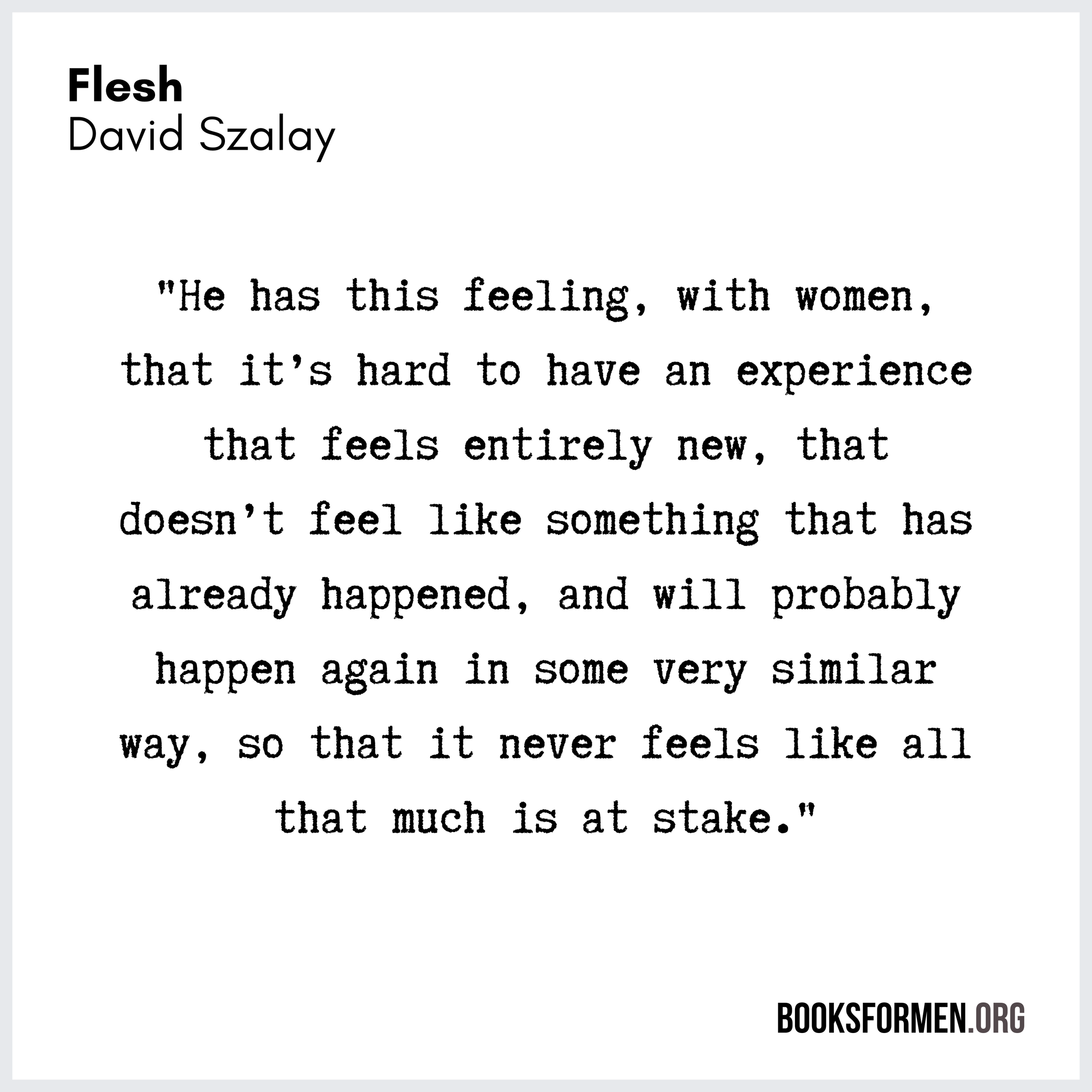
08:33 - The novel is also about, in a broader sense, classism and power, and I just found it really fascinating to think about all the powerful people in society that we perhaps admire, being children with skeletons guiding their behavior patterns. Everyone is rooted in their childhood, for better or worse, and many times those foundations are unsavory, albeit at no fault of the individual. It's just part of living. But to exempt people from this based on status or anything external is, in my estimation, an oversight of grave proportions. And I think this book does a really good job at shining a light on that. So I could go into great detail talking about the coping mechanisms and the complex interiority of the male experience. But I think you gather what I am trying to say and the important aspects of this book. So I will leave it at that and just wrap it up with one of my favorite quotes from the book. And Szalay writes, “He realizes that the things that are so important to him, the things that happened and he saw there, the things that left him feeling that nothing would ever be the same again. They just aren't important here. Those things have no reality here. That's what it feels like. So it makes you feel slightly insane or something to have those things inside you when they seem to have no reality here.”
10:13- All right, so that's all I've got officially. I hope you enjoyed this episode. I hope you will pick up the book. I think there are a lot of ways that this book will hit home for any male reader out there, even if you don't relate to the exact experience that our protagonist is having. There's a lot thematically that I think will hit home. Having said that, I want to remind you to please click subscribe on whatever podcast platform you are listening to this on, because in doing so, it is the best way for new listeners to find the show as well as inspire more men to read. If you want to reach out to me, there are two ways to do so: either on Instagram @DouglasVigliotti. It's the only social media that I have, or via my website, DouglasVigliotti.com. Maybe you want to check out my latest book, “Aristotle for Novelists: 14 Timeless Principles on the Art of Story”. In that case, you can visit AristotleforNovelists.com. Last but not least, I wanted to thank you so much for listening and remind you that if you want more information on this podcast specifically, which includes signing up for that newsletter I mentioned at the top of this episode, then all you have to do is head over to the website BooksforMen.org.