#291 | Can a Literary Thriller Retelling of ‘Huck Finn’ Alter Your Perspective on American History, Freedom, and Identity?
Quick SUMMARY:
Douglas Vigliotti discusses "James" by Percival Everett, a 2024 literary novel that retells "Adventures of Huckleberry Finn" from Jim’s perspective. Vigliotti explores Everett’s prolific career, the novel’s genre-blending style, and its powerful examination of racism, freedom, agency, and American identity, emphasizing the transformative power of fiction. He highlights how "James" offers a fresh, affecting take on a classic story, and praises its readability and perspective-shifting approach, encouraging listeners to read the book.
Listen to the episode:
LISTEN ON: Apple or Spotify 🎧
*Subscribe to The Books for Men Newsletter, a monthly round-up of every episode with full book and author info, all the best quotes, and newsletter-only book recommendations!
TOPICS COVERED IN the EPISODE:
Introduction & Newsletter Promo (00:09) - Douglas introduces "James" by Percival Everett, mentions its popularity, and plugs the podcast's companion newsletter.
About Percival Everett and His Work (01:11) - Overview of Everett’s prolific career, genre blending, social themes, and his novel "Erasure" adapted into "American Fiction."
Hollywood Adaptations and Staying on Track (02:38) - Discussion of book-to-film adaptations, particularly endings, and a segue back to discussing "James."
Summary of "James" and Its Perspective (03:43) - Explains "James" as a retelling of "Huckleberry Finn" from Jim’s perspective, highlighting its originality and focus on racism.
Retellings as a Literary Subgenre (04:58) - Explores the popularity and appeal of retellings, citing examples like "Demon Copperhead" and modern stage adaptations.
Impact of "James" on Understanding Racism (06:13) - Describes how "James" changed Douglas’s view on racism and the power of fiction to alter perspectives.
The Power of Narrative and Fiction (07:35) - Emphasizes the importance of narrative over facts, referencing his own book "Orbital" and the immersive quality of fiction.
Readability and Style of "James" (08:49) - Highlights the book’s easy, propulsive style, dialogue, and why it’s accessible despite its serious content.
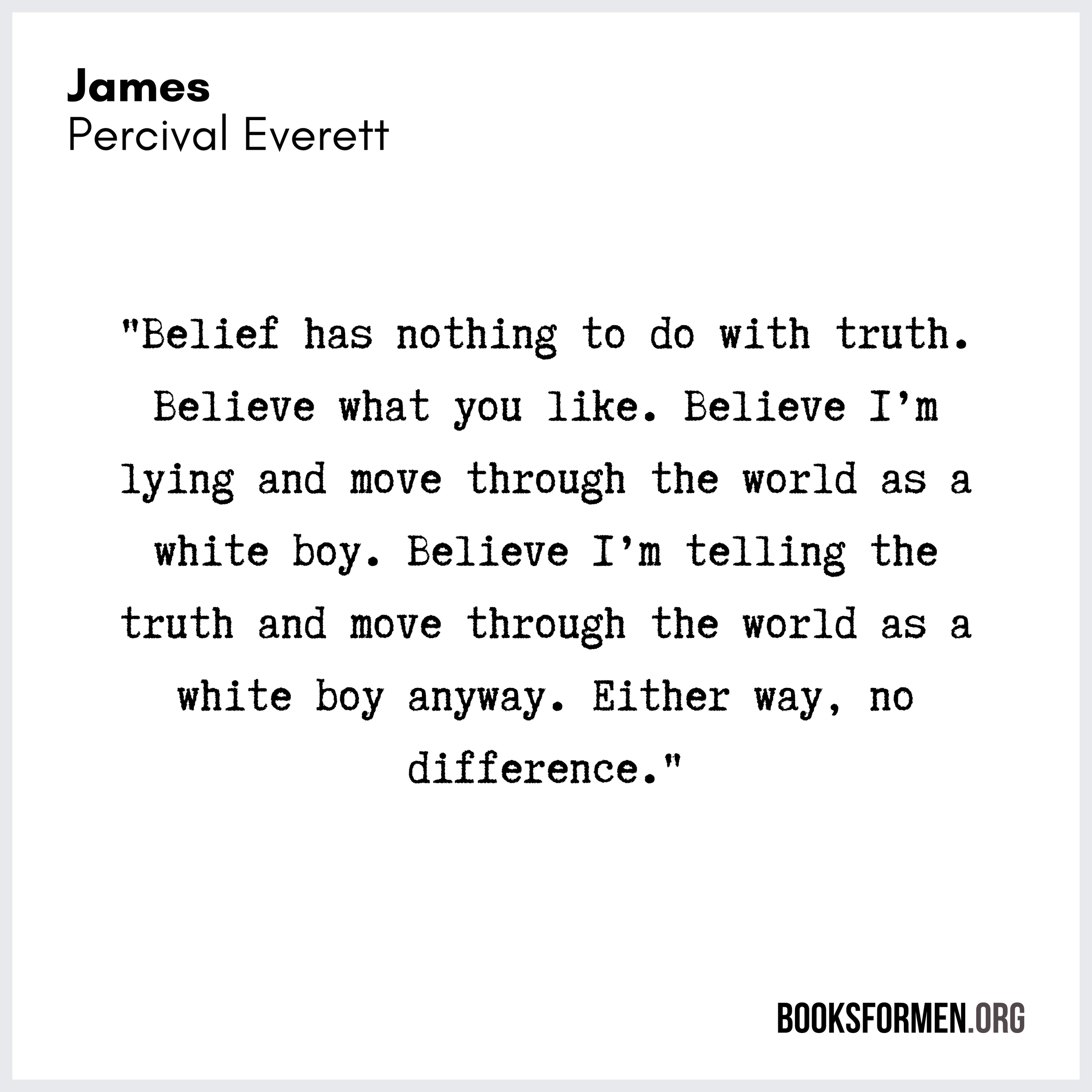
Favorite Quote and Philosophical Reflection (09:44) - Shares a favorite quote from "James" about belief and truth, reflecting on its philosophical depth.
Closing Remarks and Contact Information (10:52) - Wraps up the episode, encourages subscribing, and provides ways to connect and learn more about the podcast.
READ THE TRANSCRIPT:
Welcome back to “Books for Men”, a podcast to inspire more men to read and bring together men who do. This week I have a piece of literary fiction to share with you. It is a new piece of literary fiction, so it came out in 2024. It clocks in at around 300 pages or so. It is called “James” by Percival Everett. You may have heard it. It sort of made the rounds. It was popular. That's how it made it to me. It was one of those things where people said, you must read it. And so I read it. I will share a lot more about it. Of course, what I took away from it, some of the things that I think are important about this work, and why I am sharing it with you, as well as more about the author. But first, I wanted to remind any new listeners out there about the companion newsletter that goes with this podcast, and that's just the once-a-month email that rounds up all of the episodes from that month, complete with full book and author information, episode summaries, all my favorite quotes, and additional book recommendations. So if that sounds like something that you are interested in, then all you have to do is head over to the website BooksforMen.org.
01:20 - All right. So first of all, Everett, who is he? He's the author of what I think is around 24 novels, if I counted correctly when I was looking at his biography. He's also penned seven poetry collections and four short story collections. So his career has been quite prolific. But it was this novel that I am sharing with you today that seemed to be everywhere, as I alluded to at the top of this episode, over the last year or two. So he won the National Book Award and Pulitzer for it, but I will share more about that in just a moment. His work crosses and blends genres like mystery, thriller, satire, and what most would consider just straight literary fiction, tackling major American social and philosophical issues like racism and identity. And again, all of these things are evident and present in the work that I'm sharing with you today. He's also an English professor at USC, and I forgot to mention this, but I will now, of course, Everett's novel “Earsure” was the book adapted for the Oscar nominated film from a few years back, “American Fiction”, in which the publishing industry is satirized for the way it positions, promotes, and ultimately rewards black literature that models and conforms to black stereotypes.
02:38 - So it was definitely a provocative work and one that resonated with a lot of people. I liked the film all the way until the end, and I'm curious to know, since I haven't read the book and I'm assumptive feeling like this is the case if Everett handles the ending a little better, as this is the thing that I find most altered for many reasons in Hollywood adaptations, even when books stick closely to the source material. This is something I talked about with “Train Dreams”, and although it stays close to the source material, the way the book ends ultimately softens it a little bit. And I'm not saying this is what happens with “Erasure” and “American Fiction”, because I haven't read the book as I just mentioned, but I could see in my pipeline in the future, reading it, because I'm really curious to see how Everett handles it versus how the film adapted it. Having said that, I don't want to get too far off track here. Let me turn to the actual book at hand, “James”, and tell you what the story is about.
03:43 - So in short, it is a retelling of an iconic piece of American literature, one you've definitely heard of before, “The Adventures of Huckleberry Finn”, or just “Adventures of Huckleberry Finn”. Many say all American literature stems from This book came out originally, I think, in 1884, but rather than retelling it from Huck's point of view, it's told from Jim's point of view. So the other main character from the original, a slave who is trying to escape to freedom, is a retelling. So Jim's character is reimagined through the eyes of Everett. And of course, this means that the plot is significantly altered and ultimately reveals who the character of Jim actually is. But given what we know about the time period, not only is it believable and sad in some respects or in a lot of respects, but it feels original in that it sheds light on racism and the many contradictions that exist in our country still to this day. Really. So I'm not going to get into all of the plot specifics, because I don't want to ruin it because of the way this book reads.
04:58 - I think not knowing what actually happens is the fun part. And I don't say that with all books all the time, but definitely with this one, because I mentioned at the top of this, he blends genres like mystery and thriller, and to me, this book definitely feels like a literary thriller, even if it's not billed as one. There's a propulsive ness to the narrative, and like all narratives of this type, not knowing what happens is pretty essential to how the book reads, feels, and eventually plays out. But there are a few reasons other than that, why I wanted to share the book with you. And first, I've never shared a retelling of a classic work on the podcast before, and it is a subgenre, one that we've seen in recent years be quite successful in the literary landscape. It's also one that's quite fun to read, if it's done tastefully and well, as this book obviously is. And I always love variation and first times, so why not this book? Other books that kind of follow in this retelling genre, one that you may have heard before, it was really big a couple of years ago, was “Demon Copperhead”, which is an Appalachian version of Dickens “David Copperfield”.
06:13 - Many seem to have done this with Jane Austen's “Pride and Prejudice” over the years, but there are many, many examples. This happens quite a bit, obviously, on the stage with revivals and altered retellings. Like even the best play that I saw last year, “Oedipus” is a modern political retelling of the classic play of the same name. Of course, this is a little different. It's not literature. But anyway, I just wanted to share the example. The second reason why I wanted to share this book with you is probably the most important, and that's because it changed the way that I viewed racism. And seeing the world through Jim really has an affecting effect on the reader. It's hard to believe anyone who reads this book honestly wouldn't feel the same way. I mean, great literature has the power to do this alter point of view, and this book definitely deepened and added a layer of perspective onto this incredibly important topic in American history that clearly leaks into the present day. In general, fiction changes the way I see things more often than nonfiction does, and I learn so much from good fiction.
07:35 - It's really a testament for me anyway. And to me, facts matter way less than narrative or story. Is everything. Something you've probably heard me yap on about many times. I mean, I wrote a book sort of on this topic, “Orbital”, which is another book that I shared on this podcast maybe a year ago or two years ago, and I will link the episode up in the show. Notes is another great example of a novel that really altered the way that I see something. I think the dramatization and the deep, immersive feel into characters really helps break through in certain situations and with certain works, and I think that James is definitely one of those works. And the last reason that I wanted to share this book with you, I think, works really well. Coming off of what I just said there moments ago. And that's its readability. It reads super easy. And for the content, this is, I think, super effective. It has a lot of dialogue. Yes, there is vernacular and dialect, but it doesn't limit your ability to read it at all.
08:49 - And that's mostly, I think, because Everett writes it in, as I mentioned earlier, a very thriller-like format. You want to know what's going to happen next? I read this book in short order, maybe two, three, four days. I can't remember how long exactly. I was on vacation in Mexico, and I finished it on that vacation, and I started it on that vacation, and it was only four days, so I can't remember the exact time, but it was fast. And that's a testament to not only the writing, the clarity, but also just the style in which it's written. And for me, it's a combination of all of these factors that makes it really easy to see why not only the book had so much national acclaim, but also the reason why you should definitely read it. All right, so I think I've done enough with this episode and book, but I will wrap this up with one of my favorite quotes, something that I typically do on these episodes here.
09:44 - Of course, if you want to hear or read more of my favorite quotes, then you can always sign up for that newsletter that I mentioned at the top of the episode. But towards the end of the novel, Everett writes Something that really stuck with me. And it's an idea in the macro sense that we've definitely touched on during past episodes of this podcast. I remember specifically with “The 25th Hour”. There's a great exchange of dialogue that gets at something similar in a different way, of course, but it's a piece of advice that Jim says to Huck at the end of the book. And Everett writes, “Belief has nothing to do with truth. Believe what you like. Believe I'm lying and move through the world as a white boy. Believe I'm telling the truth and move through the world as a white boy anyway. Either way, no difference.” Man, there's so much to that quote in philosophical idea, especially when it's read in the context of the narrative. Maybe that's reason enough for you to go pick up the book.
10:52 - All right, so that's all I've got. I hope you enjoyed this episode. If you did, I want to remind you to please click subscribe on whatever podcast platform you are listening to this on, because that is the best way for new listeners to find the show and, in return, inspire more men to read. If you want to get in touch with me, there are two ways to do so: on Instagram @DouglasVigliotti. It's the only social media that I have or via my website DouglasVigliotti.com. Maybe you want to check out my latest book, “Aristotle for Novelists: 14 Timeless Principles on the Art of Story”. In that case, head over to AristotleforNovelists.com. Last but not least, I wanted to thank you so much for listening and remind you that if you want more information on this podcast specifically, which includes that newsletter I mentioned a few times throughout this episode, then all you have to do is visit the website BooksforMen.org.